When telling a story the history of the The Romagna Riviera between the 1970s and 1980sWell, it’s impossible not to mention Maurizio Zanfanti, known to everyone simply as “Zanza”.
More than just a figure, he was a cultural phenomenon. More than just a man, he became a symbol of a unique era in which Rimini was the European capital of holidays, freedom and carefree living.
Born in Rimini in 1955 into a modest family, Zanza grew up on the Riviera which was experiencing an economic and tourism boom. At just seventeen, he began working in nightclubs as a tout and later as an entertainer and ‘doorman’ at the famous nightclub Blow Up, one of Rimini’s nightlife hotspots. It was right there that his legend began.
In the 1970s, Rimini was something that is hard to imagine today. Every summer, hundreds of thousands of tourists would arrive from Germany, Sweden, Norway, Denmark, the Netherlands, France and the United Kingdom.
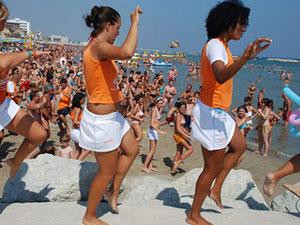
The beaches were packed, the hotels were fully booked and the nightclubs stayed open until dawn. The Riviera was synonymous with fun and freedom, especially for young women tourists from Northern Europe who saw Italy as the land of sunshine, the sea and Mediterranean charm.
It was in this context that Zanza built his legend. Long blond hair, tanned skin, shirts left open at the chest, cowboy boots and an extraordinary self-assurance. He was a regular fixture every evening in the most popular nightspots and spoke several languages, winning over foreign female tourists. His fame grew rapidly, eventually spreading beyond Italy’s borders. Even the newspaper German Bild It devoted extensive news coverage to him, turning him into a true international celebrity.
According to his own accounts, he is said to have had thousands of romantic relationships over the course of his life. The figures cited by Zanza have always remained part of the legend and cannot be verified, but what no one has ever disputed is the fact that he had become the the most famous figure of the Romagna nightlife scene. For many hoteliers and tour operators, she embodied the very essence of the Riviera: cheerful, outgoing, alluring and capable of inspiring the dreams of millions of holidaymakers.
The accounts of those who lived through those years paint a picture of a Rimini that is completely different from the city we know today.
The evenings would begin on the beach with aperitifs, continue in the restaurants of Marina Centro and end in the nightclubs that have shaped the history of the Riviera. Places such as the Blow Up, Number One, Paradiso, Altromondo and then the Imperial Bay They were the centre of Italian and European social life. The night seemed to go on forever, and figures such as Zanza had become real tourist attractions.
Many female tourists returned to Rimini year after year, not just for the sea, but to rediscover that unique atmosphere of friendships, summer flings and carefree fun. Stories sprang up around Zanza, anecdotes and legends that helped to build the myth of the Riviera. Some regarded him as a modern-day Casanova, others as a sort of unofficial ambassador of the Tourism in Romagna. He himself liked to say that he had done more to promote Rimini than many advertising campaigns.
As the years went by, the Riviera changed. The advent of the low-cost flights, competition from overseas destinations and changing tourist habits marked the end of that unique era. But the character of Zanza continued to live on in the collective imagination as the last representative of a time when Rimini was truly the European capital of holiday.
When he died in September 2018, newspapers across Europe began writing about him once again. Not so much for his romantic conquests, but because with him a piece of The Riviera of the Roaring Twenties. Many remembered him as the face of a carefree Romagna, capable of welcoming the whole world with a smile and an inexhaustible zest for life.
Today, the name Zanza continues to arouse curiosity and nostalgia. Beyond the legend, it remains the symbol of a historic era that made Rimini famous throughout the world: that of endless summers, nights out in discos until dawn, beaches teeming with young Europeans, and a Riviera which, between the 1970s and 1980s, embodied the Italian dream of the Adriatic ‘dolce vita’.