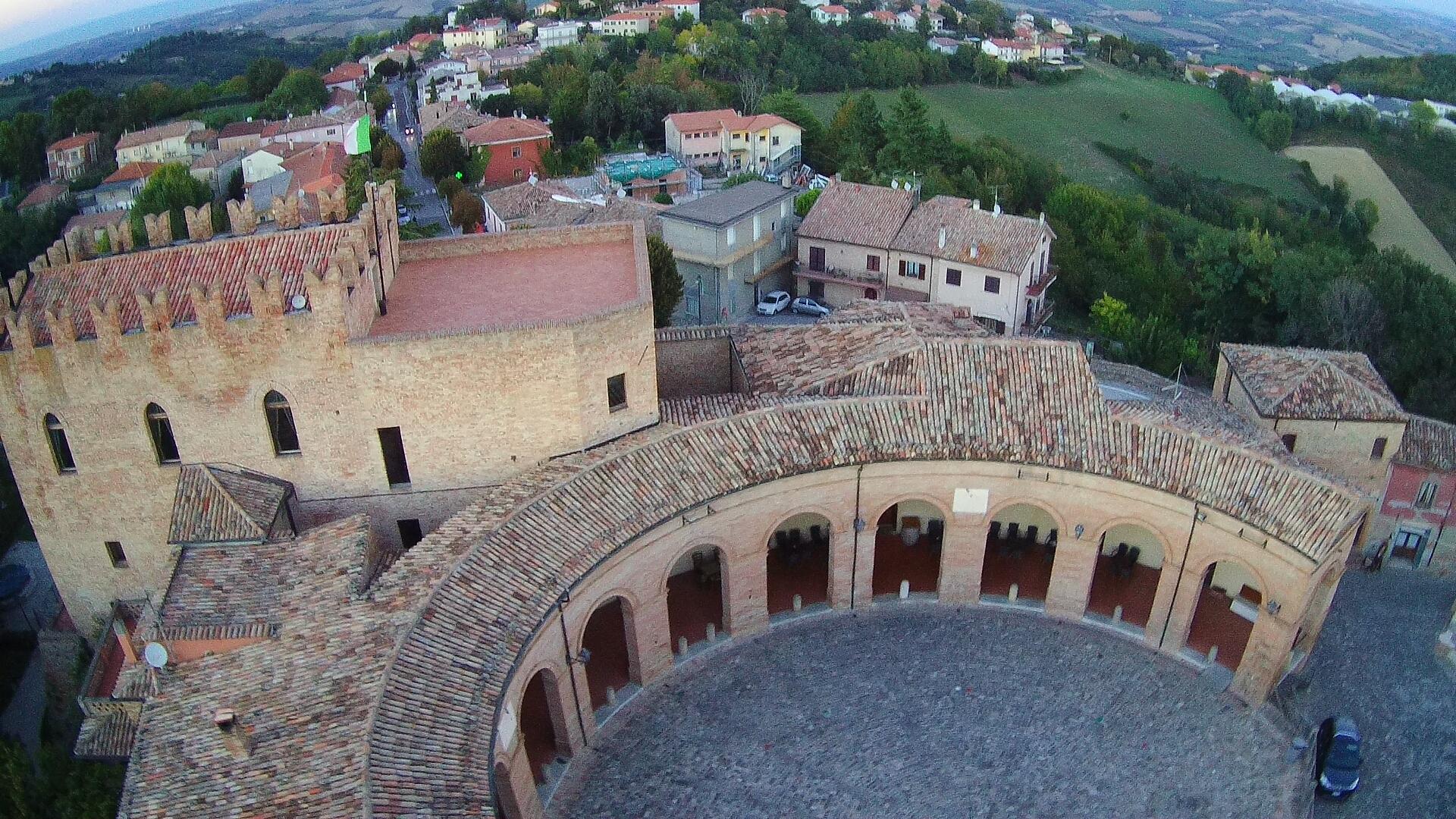
You simply need to have the sea behind you to admire the hill that shelters the city; hamlets, fortresses, villages, olive groves and vineyards form the backdrop to ‘the other Rimini’.
Valmarecchia :
A valley surrounded by hills, home to typical villages of the Tuscan-Emilian Apennines. Sant’Arcangelo di Romagna is a medieval village, characterised by its narrow streets and stairways winding uphill towards a hilltop where the Rocca Malatestiana stands, seemingly clinging to the hillside.
Poggio Berni: divided into Poggio Alto and Poggio Basso, a small village where you can visit an old mill that is still in working order.
Montebello and Torriana: a picturesque spot, situated on two small adjacent promontories, two hilltop villages – or hamlets, to be precise – dating back to the 13th century; traditions and legends that straddle the line between the sacred and the profane, together with a beautiful sanctuary, make these two hamlets well worth a visit. Verucchio: famous above all for its magnificent fortress, a testament to the Malatesta family’s presence and also mentioned by Alighieri in his famous *Divine Comedy*; it is also home to an archaeological museum where visitors can view artefacts dating back to the Etruscan era.
Valconca :
A valley renowned for the festivals organised in the villages that make up the valley itself. Mondaino: known as the ‘village of the fallow deer’, home to a beautiful Malatesta fortress; its round square is particularly lovely and is therefore known as ‘Piazza della Padella’. Also in the Valconca, worth visiting are Saludecio, a village that still retains its Renaissance-style town layout, and San Leo, which boasts one of the most striking Malatesta fortresses, having been built on a rocky outcrop; it is said that Cagliostro was once held prisoner in this fortress’s dungeons.