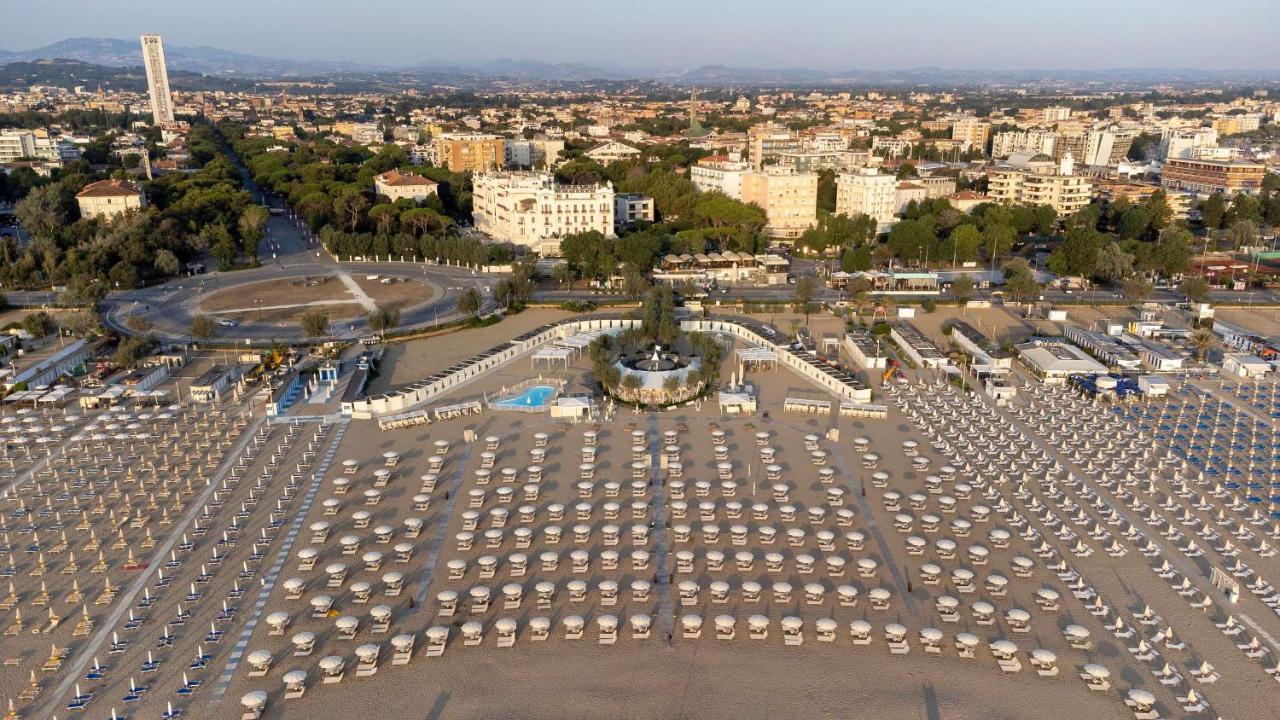
Brisighella (Briṣiġèla in the Romagna dialect) is a Italian municipality by 7,173 inhabitants, situated in the Province of Ravenna, in Emilia-Romagna, a 115 metres above sea level, in the lowlands Lamone Valley on the slopes of theTuscan-Romagnolo Apennines.
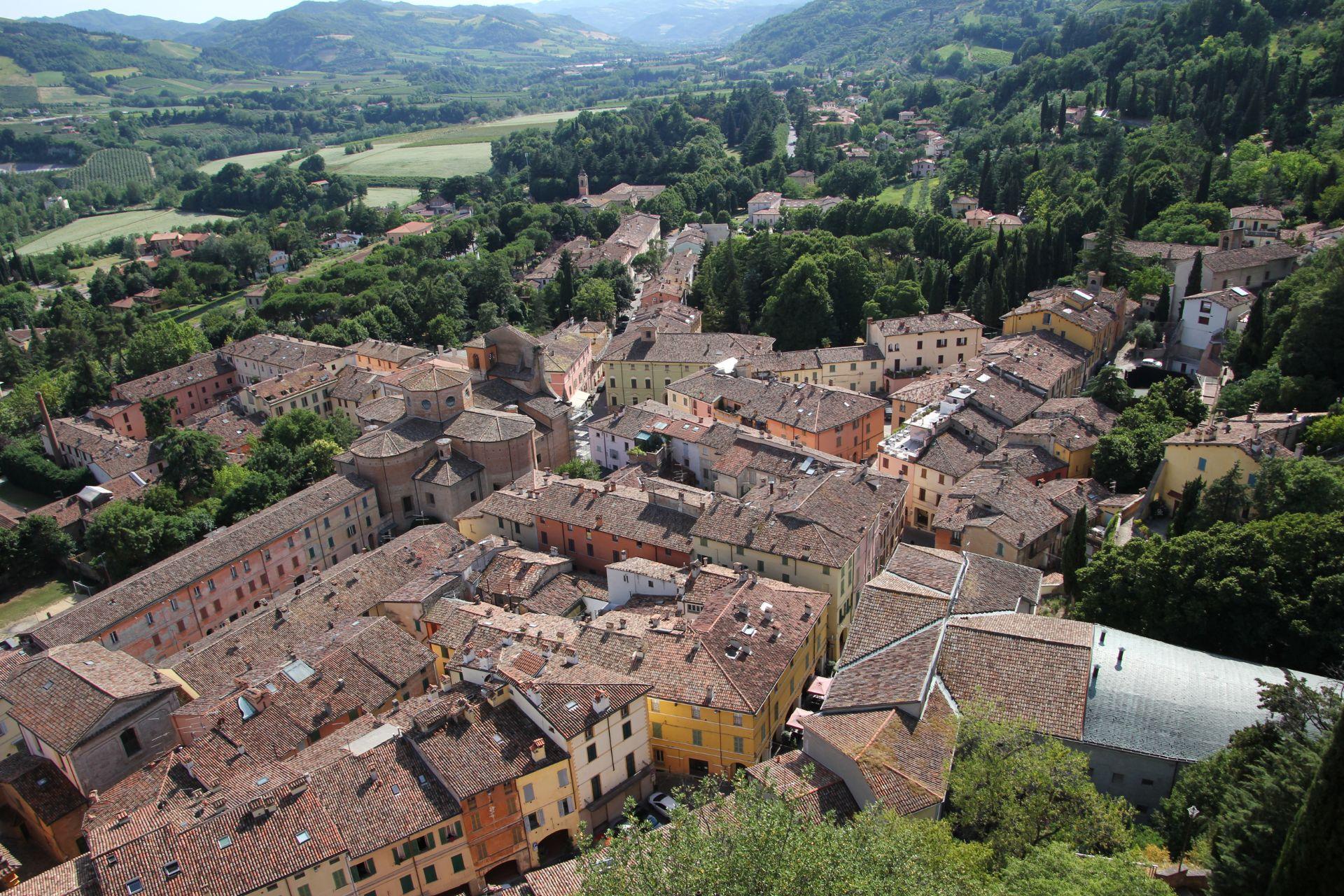
The village is famous for its three distinctive rocky pinnacles known as the “Tre Colli”, on which the following are located:
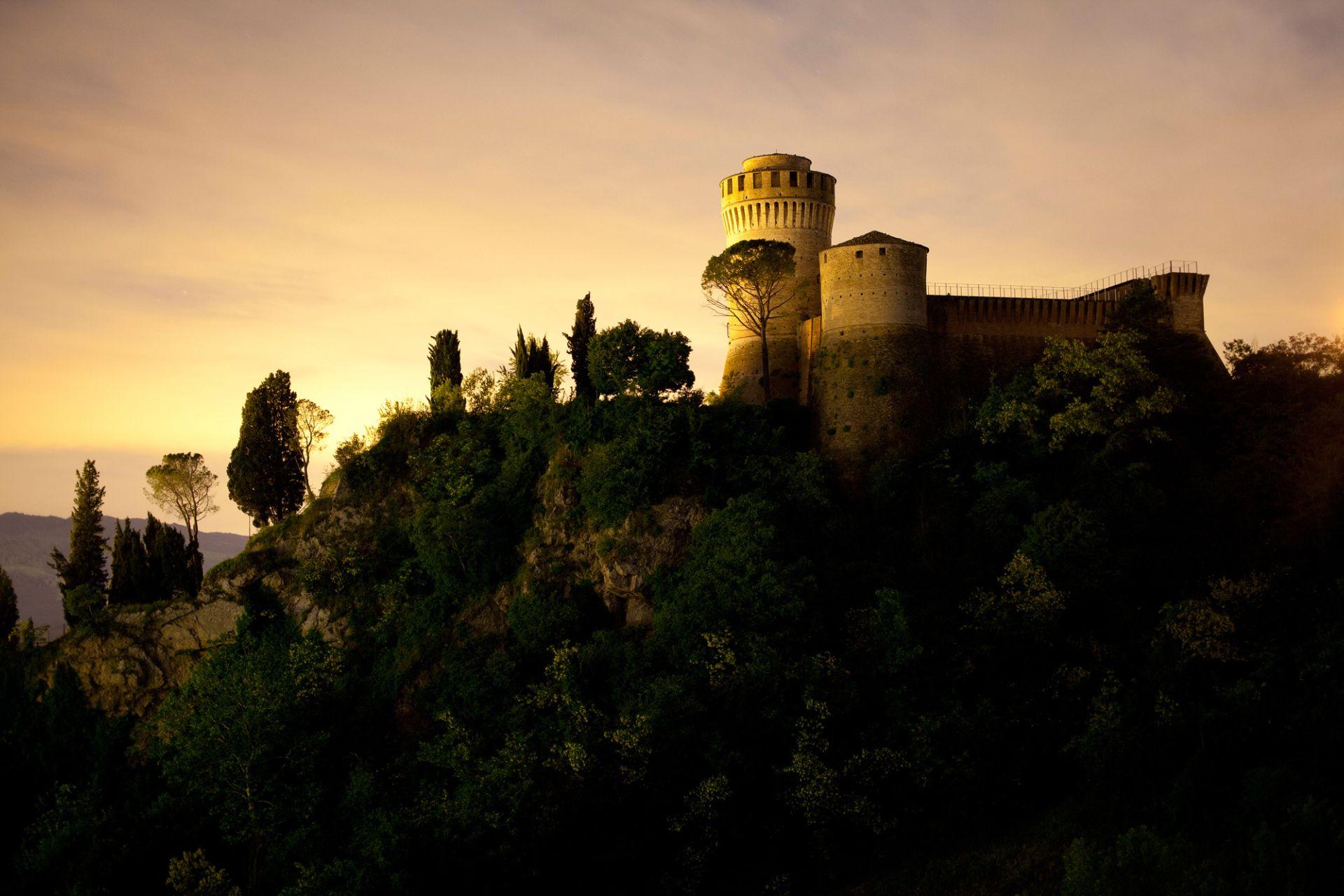
- The Manfredian Fortress (14th century), an imposing medieval fortress.
- The Monticino Sanctuary (18th century), a place of worship and pilgrimage.
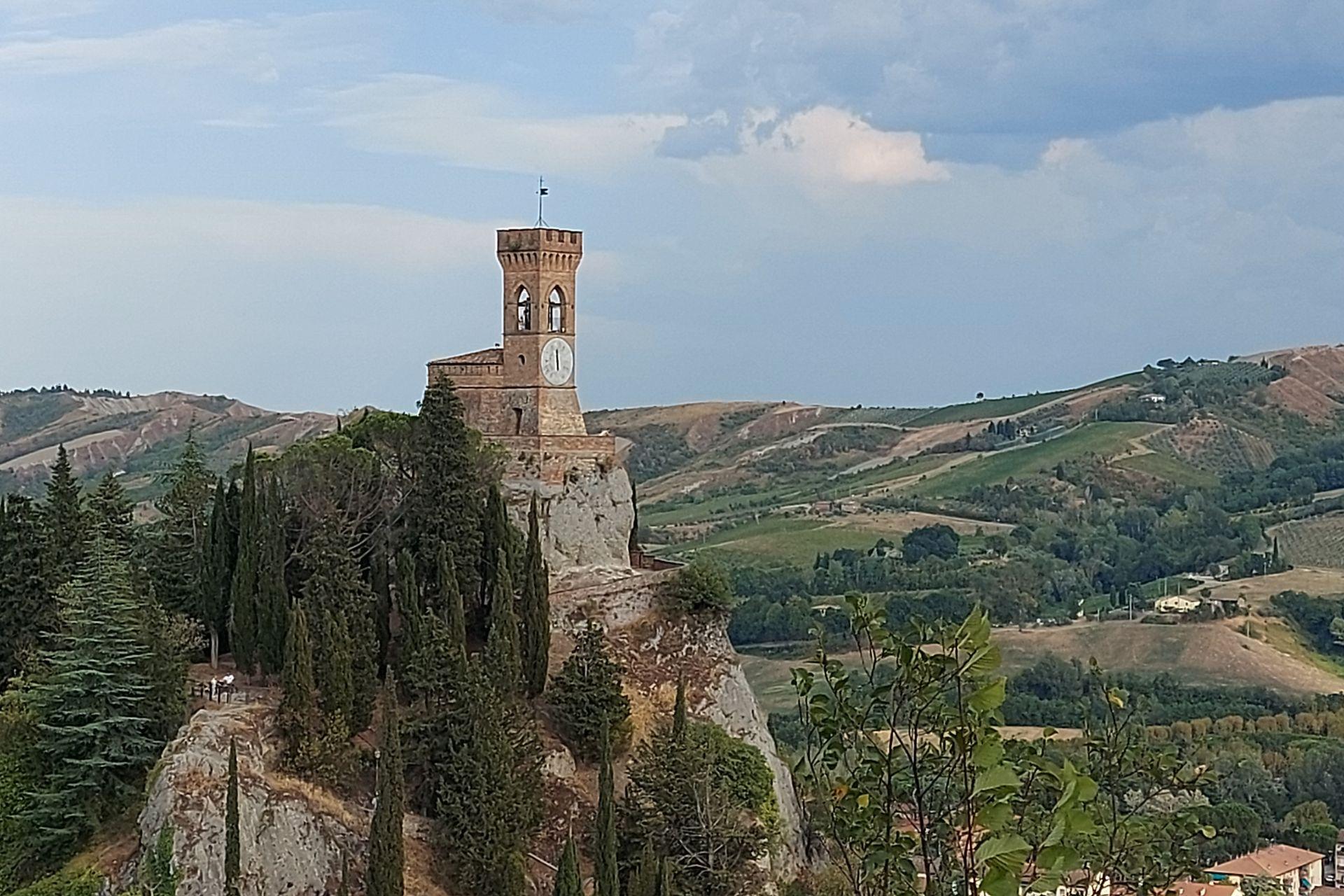
- The Clock Tower, rebuilt in the 19th century on the ruins of a 12th-century defensive settlement.
The municipality of Brisighella is the the southernmost part of the province of Ravenna. The county town is situated about 12 km upstream from Faenza and to 50 km south-west of Ravenna, near the first hills of theFaenza Apennines. The city is crossed by the the River Lamone, which flows through the valley of the same name, straddling Tuscany e Romagna.
Brisighella borders:
- To the south with the Tuscany (Metropolitan City of Florence), in the area of the Mugello.
- To the south-east with the province of Forlì-Cesena, between theFaenza Apennines and theThe Forlì Apennines.
Origins of the name
The place name Brisighella sets out various hypotheses regarding its origin:
- According to some scholars, it is thought to derive from the pre-Latin term Brisca o Bresca, with regard to the land porous, hilly. This ties in with the meaning of the Romagnolo dialect Brisca (honeycomb) and Sicilian Briscale (spongy soil).
- Another, more likely theory links him to bréṣega, a term used in the Polesine to indicate a small plot of land. This term is, in turn, associated with the Italian crumb and gave rise to place names such as Breṣega e Breṣeghina in the same area of Polesine.
The History of Brisighella
The origins of Brisighella date back to the end of the Two hundred, when Maghinardo Pagani, a local warlord, built one of the most important strongholds of the Lamone Valley. Subsequently, in 1310, Francesco Manfredi, Lord of Faenza, built another fortress on a different hilltop. The structure was extended and fortified by Astorgio Manfredi in the middle of the Four hundred and completed by the Venetians in 1508, with the construction of the tallest tower and the incorporation of the city walls.
Development of the village
Its strategic location along the the road at the bottom of the Lamone valley, the abundance of plaster (used as a building material and a commodity), and the presence of fortifications encouraged Brisighella’s growth as a settlement.
Between 1356 and the 1376, the village was a direct possession of the Pope, before falling back below the Manfredi, which in the 1411 They designated it as the main town of the Lamone Valley.
Astorgio II Manfredi (1457–1466) endowed the village with a city walls with three doors:
- Gabalo Gate (east),
- Bonfante Gate (west),
- Fiorentina Gate (south, originally known as Porta delle Cannelle).
In 1459, the Community Centre, the seat of the local government, and the main squares were designated as follows:
- Piazza del Monte, dedicated to the Wednesday market.
- Marconi Square, the heart of community life.
From the Venetian period to the 19th century
After a brief period of Venetian rule, in 1509 Brisighella returned to the control of the Papal State. From Five hundred, the village expanded beyond the walls, with new houses built along Via dell’Abbondanza, Via Roma and Via Baccarini.
The city was hit by three devastating earthquakes at 1625, 1690, and 1781, the second of which also caused serious damage to the fortress.
Between 1824 and the 1832, as part of the project by Antonio Melari e Giuseppe Mascolini, were built on Town Hall in the Neoclassical style and the Pedrini Theatre. The road network was improved by relocating the provincial road to a new route, thereby easing traffic flow. The Torsello Tower she was replaced in the 1850 from the current Clock Tower.
In 1859, with the incorporation of the Papal Legations into the Kingdom of Sardinia, Brisighella became part of the Kingdom of Italy. The rail link with Florence and Faenza, completed in 1887, and the construction of an aqueduct in the 1896, marked a significant turning point for the village.
The 20th and 21st centuries
In The 20th century, Brisighella underwent a number of changes:
- The population growth in the period immediately following the First World War was followed by a sharp decline after the Second World War.
- In 1959, the “Giuseppe Ugonia” Vocational Training College.
- In 1962, the new spa centre.
- The Museum of Rural Life It was established in the Rocca in 1977.
In the 1990s, a major restoration programme was launched for the historic centre, including works such as the resurfacing of Marconi Square at 2000.
Scientific research
From 1972, Brisighella is home to the Brisighella Heart Study, a research project at the University of Bologna, launched by Professor Giancarlo Descovich and continued by Professor Antonio Gaddi, focusing on cardiovascular risk factors.
Symbols of Brisighella
Coat of arms
The coat of arms of the Municipality of Brisighella It was officially recognised by a decree dated Head of Government the 25 July 1937 and subsequently amended by a decree of President of the Republic the 28 December 1965.
The official description reads:
‘Azure, a green terrace supporting a leaping goat in natural colour.’
The goat (or beak) could be atalking gun, with reference to the The Lordship of Beccusano, to which Brisighella was subject. Alternatively, the goat might allude to the existence of an ancient Roman temple dedicated to Jupiter Ammon, situated where the Parish Church of St John in Ottavo.
Banner
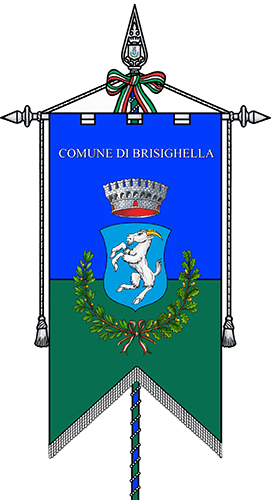
The municipality’s banner is a a banner divided into azure and green, drawing on the colours and symbols of the town’s coat of arms.
Monuments and places of interest
The three hills of Brisighella
Brisighella is characterised by its three selenite nuggets, on which the most important architectural landmarks are situated:
- La Manfredian Fortress,
- The Monticino Sanctuary,
- La Clock Tower.
Religious architecture
- Church of St Michael the Archangel
The village’s parish church dates back to 17th century. - Monticino Sanctuary
Built in 1758-59, houses a sacred terracotta image of the Madonna and Child (1626). The interior is decorated with Ionic pillars, fine marble and frescoes by Savino Lega. The façade was extended in 1926. La Shrine Festival takes place every September from 1662. - Parish Church of Santa Maria in Tiberiaco
Situated on Monte Mauro, it was built in 6th century at the behest of the Byzantine emperor Maurizio. Reduced to ruins in the 20th century, it was restored in the first decade of the 21st century. - Parish Church of St John the Baptist in Ottavo
Known as Pieve del Tho, was built between theVIII and the 10th century. The Romanesque interior has three naves and houses a altar frontal from the early Middle Ages and a painting attributed to Benedetto Marini. - Church of the Osservanza
Built in 1520, houses a painting of the Madonna and Child with Saints by Palmezzano.
Military architecture
- Manfredian Fortress
Built in 1228 and expanded over time, it features cylindrical towers, the tallest of which dates back to 1503. Ruled by the Manfredi family, it was conquered by the Venetians and then by the Papal States. - Clock Tower
Rebuilt in 1850 Built on the site of a 13th-century tower, it is one of the village’s landmarks.
- Torre del Marino
Built in 1460 Built by the Naldi family as a watchtower, it overlooks the Senio Valley. It sustained damage during the Second World War but still retains elements of Renaissance military architecture. - Torre Cavina and Torre Pratesi
Built between the 14th and 15th centuries, they ceased to serve a military purpose in the 17th century and were converted into hunting lodges. - Rontana Castle
First mentioned in the 973, was demolished in 1591 by Pope Gregory XIV to prevent it from being used as a hideout by bandits. - La Torretta
A medieval sandstone fortification, now incorporated into a farmhouse.
Civil architecture
- Via degli Asini
A picturesque elevated road covered by arches, once used to transport materials from the gypsum quarries by caravans of donkeys. It is one of Brisighella’s most distinctive streets. - Old Fountain
Built in 1490, is the oldest public fountain in the city. - War Memorial – The Sleeping Soldier
A bronze sculpture by the sculptor Domenico Rambelli.
Brisighella boasts a rich historical and architectural heritage, which bears witness to the town’s strategic and cultural importance over the centuries.
Natural areas
Part of the municipal area of Brisighella is included in the Vena del Gesso Romagnola Regional Park, one of the most important protected natural areas in Emilia-Romagna. This park is characterised by the Vena del Gesso, an imposing chalk ridge that runs through the Tuscan-Romagnolo Apennines, offering a unique landscape consisting of gorges, natural caves, and extraordinary biodiversity.
In 1952, major refurbishment work was carried out on the the badlands of Brisighella, helping to protect and enhance the area, which is now a popular destination for walkers, nature lovers and geology enthusiasts.
The park is a treasure trove for nature conservation and offers numerous footpaths and trails for exploring the beauty of the landscape and the richness of the local flora and fauna.
Religion
In the Collegiate Church In Brisighella, the image of the Our Lady of Grace, a devotion that has its origins in the 15th century and is from Faenza.
Tradition has it that, in the 1412, during a terrible plague epidemic, the Virgin appeared to the noblewoman Giovanna Sagramori whilst praying in the Church of St Dominic in Faenza. As a token of gratitude for the many graces received, an image of the Virgin Mary was painted on a wall.
Towards the 1450, a local painter created a painting on three oak panels depicting the Blessed Virgin of Grace, in the same iconography as the image venerated in Faenza: the Virgin holds in her hands six broken arrows, a symbol of the end of the plague thanks to her intercession.
One of these panels was purchased by a wealthy family from Brisighella, who kept it in their home until, in accordance with their will, it was donated to the archpriest of Brisighella on condition that it be displayed for public veneration in the Parish Church.
In 1632, as a token of gratitude for the graces granted during another epidemic (the famous plague described by Manzoni), the image was solemnly crowned, further strengthening the bond between the people of Brisighello and Our Lady of Grace. Today, the sacred image is kept in the archpriest’s church and is the object of deep devotion.
Culture
Museums
- “G. Ugonia” Civic Museum
Established through the bequest of 400 works by the painter and lithographer Giuseppe Ugonia (1881–1944), also includes a collection of a thousand engravings by various 19th- and 20th-century authors. From the 1970, is based in the former magistrates’ court building. - Museum of Rural Life
Founded in 1977 With the aim of preserving agricultural tools threatened by industrialisation, the museum was established thanks to the painter’s collection of tools Elvio Cornacchia and is based in the Rocca. - Museum of the Resistance
Also known as Permanent exhibition at the Cà Malanca Resistance Documentation Centre, was established in 1990 to recount the events of the 1944-1945, when the Allied advance came to a halt along the Gothic Line. It is situated in the hamlet of Fornazzano. - Open-air Geological Museum – Former Monticino Quarry
This geological museum offers a unique insight into the local geology, making the most of the natural landscape of a disused quarry. - Cà Carnè Visitor Centre
It houses an exhibition of stuffed animals representing the wildlife of the Romagnola Gypsum Vein Park.
Literature
The dramatic conclusion of the historical novel The cardinal’s son (The Gadfly, 1897) by the Irish writer Ethel Lilian Voynich is set in the Brisighella Fortress. Although little known in Italy, the book was a great success in communist countries during the Cold War.
Kitchen
- “Brisighella” PDO olive oil
Brisighella is renowned for its top-quality olive oil, which has been awarded the Protected Designation of Origin (PDO). - Sangiovese di Romagna D.O.C. wine
The area falls within the production area of the famous Sangiovese from Romagna, a wine that epitomises the local winemaking tradition. - Moretto Artichoke
A traditional speciality of the Brisighella hills, this artichoke is included in theSlow Food’s Ark of Taste, which protects traditional culinary specialities.