Pietro da Rimini (Rimini, … – c. 1345) was an Italian painter active in the first half of the 14th century, regarded as one of the most representative figures of the so-called The Rimini School of Giotto. Although his life and work are shrouded in biographical and critical uncertainty, his work left a profound mark on the artistic landscape of the fourteenth century, spanning Rimini, the Marche and Emilia-Romagna.
Biography and education
Little is known about the life of Pietro da Rimini. The only confirmed signature is the one on the The Crucifix of Urbania, where the name appears Petrus de Arimino. However, on the basis of stylistic similarities, numerous other works have been attributed to him over the years, making him the most representative of the Giotto-inspired artists active in Rimini during the early decades of the 14th century.
It is likely that Pietro was a pupil or a direct follower of Giotto, who worked in Rimini around 1310. His works indeed display a style influenced by the innovations in perspective and volume introduced by the Florentine master, but also a refined narrative sensibility more closely aligned with the Sienese school, in particular with Pietro Lorenzetti.
Between Rimini, Tolentino and Pomposa
Pietro da Rimini operated within a diverse and still-evolving artistic milieu. Over the years, art historians have sought to define the scope of his work, distinguishing it from that of other Rimini masters active during the same period, such as Giuliano of Rimini, Giovanni Baronzio, or the so-called Masters of San Pietro in Sylvis e of Santa Maria in Porto Fuori. Pietro shares stylistic and thematic elements with these artists, to the extent that this has given rise to frequent cross-attributions and speculation about the existence of a shared workshop.
One of the key works is the cycle of frescoes in the the refectory of Pomposa Abbey (1315–1320), which has been attributed to him in collaboration with Giovanni Baronzio: here, in the scene of theThe Last Supper and in those depicting the life of Saint Guido the Abbot, a strong narrative quality emerges, along with a synthesis of traditional iconography and spatial experimentation.
Another important complex is the The dome of the Basilica of St Nicholas of Tolentino, where Pietro is thought to have worked (1320–1325) alongside Giuliano da Rimini. Here, the decorative cycle depicts episodes from the life of Christ and Saint Nicholas of Tolentino in a style that is both understated and moving, conveying a sense of dramatic intensity and spirituality.
Mobile works and disputed attributions
Apart from his frescoes, Pietro da Rimini is also noted for a series of works on panel, including:
-
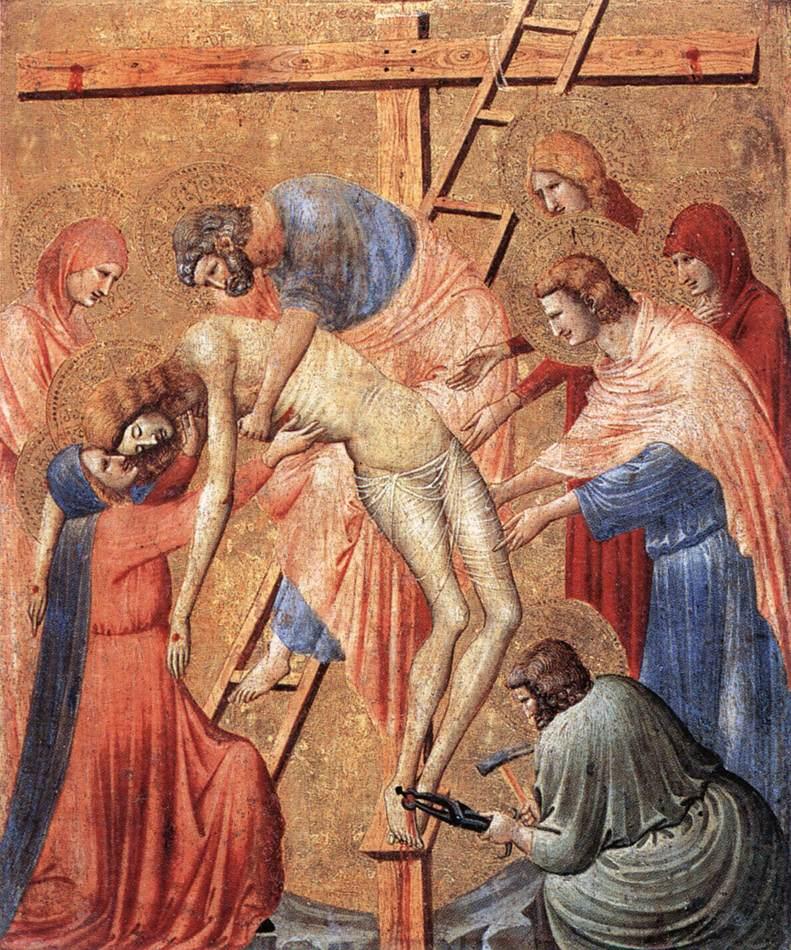
La The Descent from the Cross (1325–1330), now in the Louvre, in which the gold ground is combined with a depiction of grief that is still rooted in Byzantine models, yet is already imbued with a new expressiveness.
-
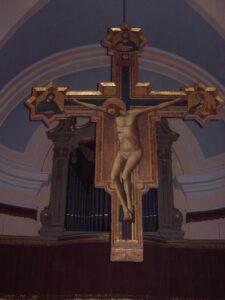
The Crucifix from the National Gallery of the Marche in Urbino, perhaps his best-known and most refined work.
-
La Madonna and Child Enthroned amongst Angels and Saints (Longhi Collection), where one can appreciate a delicate balance between solemnity and tenderness.
-
The fresco by St Francis (1333) in the church of the same name in Montottone, originally from Jesi, where the saint appears both solemn and deeply human at the same time.
However, there is no shortage of problems with attribution: the Crucifix from the Collegiate Church of Santarcangelo di Romagna It is now regarded by many as the work of Master of the Refectory at Pomposa, whilst some paintings and frescoes once attributed to Pietro have been reattributed to the Master of Santa Maria in Porto Fuori.
The legacy and the style
Pietro da Rimini’s style is characterised by a constant tension between innovation and tradition. His figures often have gentle, melancholic faces with meditative expressions; the drapery is carefully rendered, though without the linear elegance typical of Sienese art; the light shapes the surfaces, yet leaves a certain formal solemnity intact.
Whilst his art may at times appear inconsistent – not least because of the various artists involved in the cycles attributed to him – it represents a crucial step in the spread of Giotto’s artistic style along the Adriatic coast and throughout central Italy.
Major works
-
Frescoes in the refectory of Pomposa Abbey (1315-1320)
-
Frescoes in the Great Chapel of St Nicholas, Tolentino (1320–1325)
-
Frescoes from Santa Chiara, Ravenna, now in the National Museum (1320–1340)
-
The Descent from the Cross, Paris, the Louvre (1325–1330)
-
Crucifix, National Gallery of the Marche, Urbino (1320–1350)
-
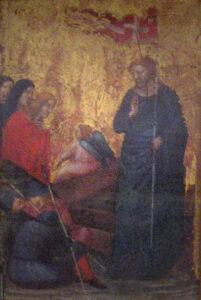
The Resurrection and *Noli me tangere*, City Museum, Rimini (1325)
-
Crucifix, Collegiate Church of Santarcangelo (1330–1335)
-
Detached frescoes from the Eremitani, Padua (1330–1340)
-
St Francis, Montottone (1333)
-
Icon of the Precious Blood, Jesi (1333)
-
Signed crucifix, Urbania, Cathedral of St Christopher (1335–1340)
Conclusion
The figure of Pietro da Rimini It comes at a crucial moment in Italian painting, between the end of the Byzantine tradition and the birth of modern representation. His contribution – often obscured by missing signatures and shared workshops – is nonetheless crucial to understanding the originality and spread of Giotto’s artistic language beyond Tuscany, in a vibrant Romagna open to artistic exchange, where emotion merges with narrative and art becomes a visual account of faith.