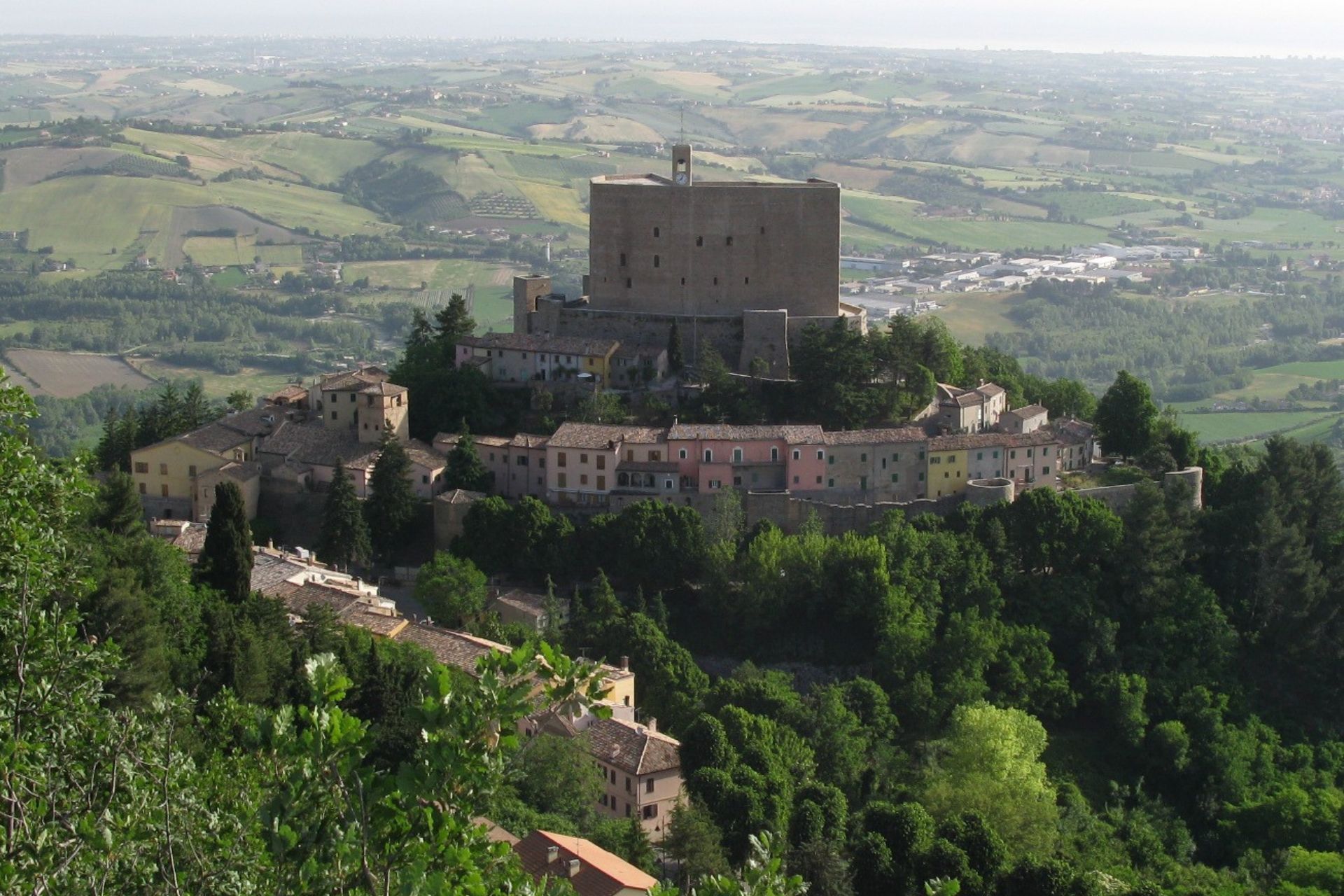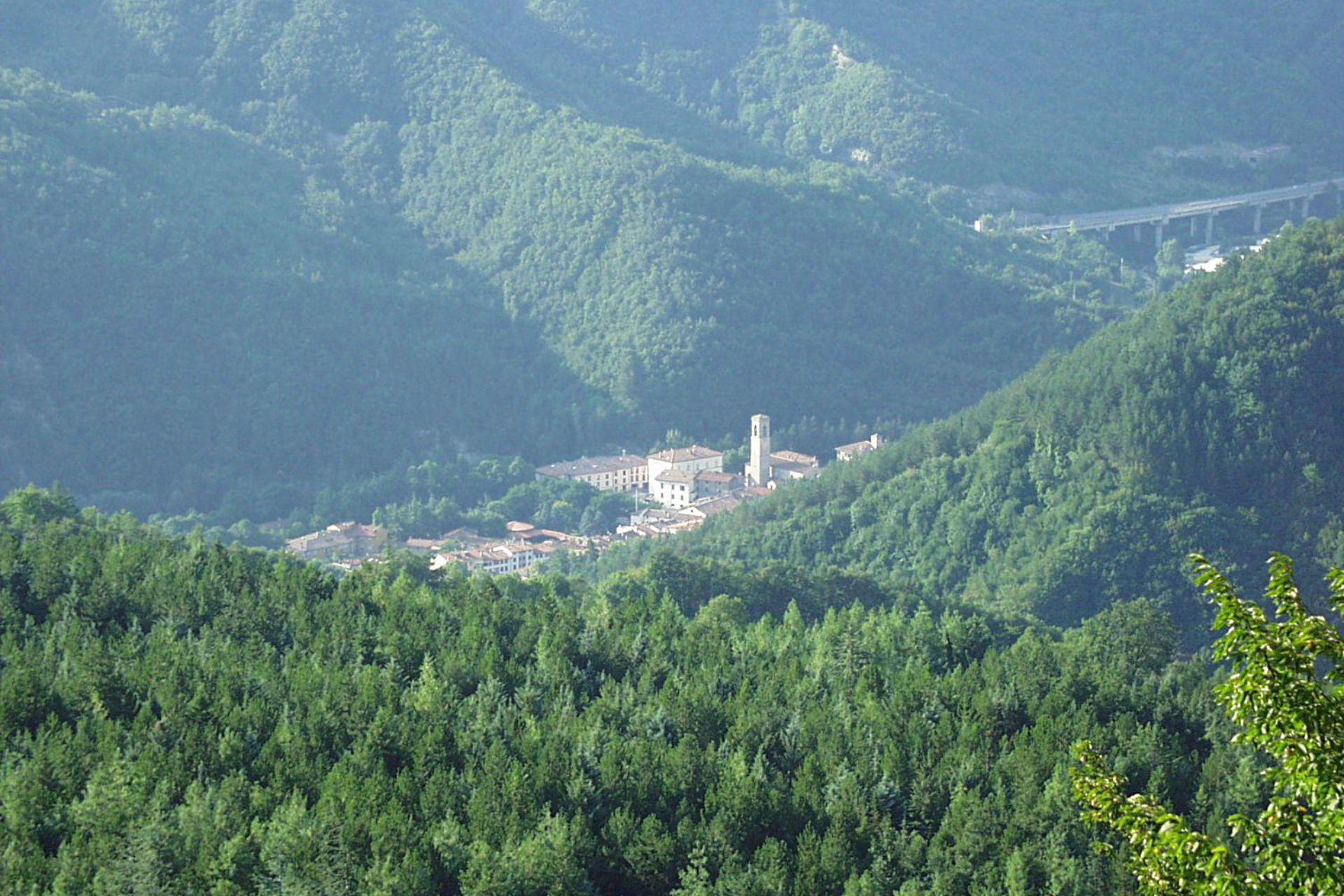
Dovadola (Dvêdla (in the Romagnolo dialect) is a small municipality with a population of around 1,600, situated in the province of Forlì-Cesena, in the heart of Emilia-Romagna. The village is situated about twenty kilometres from Forlì, nestled in the picturesque landscape of the Montone River valley, along the ancient road linking the From Romagna to Tuscany.
Perched on a cliff Overlooking the river, the village still retains thethe compact and distinctive character of historic towns in the Apennines, surrounded by hills covered in woods e farmland.
Ancient origins among the Celts and Romans
The village has a very long history. The name Dovadola is thought to derive from Latin “duo vadora”, meaning “two fords”, with regard to the two crossing points over the River Montone in this area, which probably contributed to the establishment of the settlement. The valley shows evidence of human presence as early as the prehistoric and, even before the arrival of the Romans, the area was probably inhabited by Celtic peoples. Evidence of Gallic settlement has come to light following the discovery of a warriors’ burial ground. Subsequently, the area was also frequented by the Romans, as evidenced by a number of tombs and coins found in the surrounding area.
The Middle Ages and the rule of the Guidi counts
During the Early Middle Ages, the region came under the influence of the Archbishops of Ravenna, who, between the 8th and 9th centuries, had the first one built fortification on the rocky outcrop overlooking the village. From the 12th century onwards, the town came under the control of the the Counts Guidi of Modigliana, one of the most important feudal families in the Tuscan-Romagnolo Apennines. It was during this period that the The castle was extended and fortified with new walls, defensive ramparts and a stately home.
In 1255, the Count Ruggero, the son of Marcovaldo of the Guidi family, together with the Municipality of Dovadola, entered into a agreement with the Municipality of Forlì, as it came under the influence of the town in Romagna. In the centuries that followed, the village was drawn into the conflicts between local lordships: In 1334, it passed to the Ordelaffi family, lords of Forlì, before returning once more to the Guidi family.
Tuscan Romagna and the Florentine period
In 1405, the Guidi counts ceded the fiefdom definitively to the Republic of Florence, which was gradually expanding its territory into what was known as Tuscan Romagna. During the Florentine period, Dovadola maintained a a strategic role in controlling the Montone Valley and the road linking Forlì with Florence.
In 1467, the fortress was conquered and set alight by the famous military leader Bartolomeo Colleoni during one of the many wars between the Italian powers of the time. The village remained under Florentine rule until 1860, when, with the unification of Italy he came annexed to the Kingdom of Sardinia e awarded in the province of Florence. Only in 1923, Along with most of the territories of Tuscan Romagna, Dovadola was incorporated into the Province of Forlì.
The historic centre and the ancient walls
Even today, the historic centre retains the urban layout of Florentine origin, with a regular, orthogonal layout stretching from the riverbed to the fortress of the Guidi Counts. As you stroll through the village’s streets, you can also see a few remains of the ancient 15th-century walls: in the northern part of the historic centre, between Via Garibaldi, Via Ranieri Biscia and Via Carbonaie, Parts of the city walls and three large circular towers are visible; today, they are partially incorporated into the surrounding houses.
The Abbey of St Andrew
One of the main monuments in Dovadola is the Abbey of Sant’Andrea, situated on a hill beyond the River Montone. Founded by Cluniac monks before the year 1000; the first documented reference dates from 1116. During the 15th century, the church was restored, taking on its present appearance, inspired by the The Tuscan Renaissance.
Inside, you can admire 16th-century frescoes and paintings from the Romagna and Bolognese schools. The abbey also houses the remains of the Blessed Benedetta Bianchi Porro, a highly venerated young mystic originally from Dovadola, whose tomb is a destination for pilgrims.
The Fortress of the Guidi Counts
Towering above the village stands the Dovadola Fortress, also known as Rocca of the Guidi family. Its origins date back to at least the 11th century, but the present structure is the result of extensions carried out between the 13th and 15th centuries. Built on the site of ancient defensive works probably already used by the Lombards, the fortress had a strategic location: Situated perpendicular to the valley, it controlled the road linking Romagna with Tuscany, serving as an important checkpoint along the Via del Montone.

Even today, the fortress dominates the surrounding landscape and it is also clearly visible from State Road 67, which links Forlì to Florence.
The Church of the Santissima Annunziata
Another notable religious building is the Church of the Santissima Annunziata, dating from the 14th century and once entrusted to the Dominican friars. The present building, which has a single nave, houses a fine 14th-century wooden crucifix.
White truffles and culinary traditions
The culinary tradition is another important aspect of the village’s identity. Dovadola is, in fact, renowned for its prized white truffle, one of the most famous produce of the Romagna Apennines.
For over fifty years, the town has dedicated a a very well-attended party which takes place every year on third and the the fourth Sunday in October, attracting visitors and enthusiasts from across the region.
The Hermitage of Montepaolo and St Anthony
In the vicinity of the village, it is also worth visiting the Hermitage of Montepaolo, situated about seven kilometres from the town centre. This place is deeply linked to the figure of Saint Anthony of Padua, who stayed here for almost a year between 1221 and 1222 in the small Franciscan friary.
Tradition has it that the saint found refuge and a place for meditation in a cave situated not far away, which can now be reached via a picturesque path known as the ‘Path of Hope’.
Over the centuries, the landscape of the area has been altered by landslides and ground movements, which have transformed the original appearance of the hill on which the first hermitage stood. The present-day sanctuary It was rebuilt at the beginning of the The 20th century and features a Neo-Gothic style with interiors entirely covered in frescoes.
In 2000, a pathway decorated with mosaics which recount the most significant moments in the life of Saint Anthony, making the place even more evocative for visitors and pilgrims.