Discovering Jewish Romagna: a journey through ghettos, synagogues and places of remembrance
When you think of Romagna, the Adriatic Sea, the beaches of the Riviera, the medieval villages, the traditional cuisine and the warm welcome that has always characterised this region immediately spring to mind. Yet there is a lesser-known side to Romagna, made up of quiet alleyways, historic neighbourhoods, monumental cemeteries, historic palaces and places that tell a story spanning centuries.
It is the Jewish Romagna, a widespread cultural heritage that still preserves valuable evidence of the presence of Jewish communities which, from the Middle Ages right up to the 20th century, contributed significantly to the region’s economic, cultural and social development. Visiting these places means embarking on a journey that is quite out of the ordinary. It is not merely a matter of discovering monuments or historic buildings, but of learning about the lives of the men and women who lived, worked and forged relationships with the local populations, leaving a legacy that is still visible in the towns and villages of Romagna.
From the alleyways of the Giudecca in Bertinoro to the charming Jewish quarter of One hundred, passing by the exquisite lapidary in Lugo, right up to the testimonies of Rimini and to the neighbour Ferrara, at the heart of Emilian Judaism, this itinerary offers a fresh, more informed and authentic perspective on the region.
The origins of the Jewish presence in Romagna
The Jewish presence in Emilia-Romagna has its roots in the Middle Ages. The earliest documentary evidence dates back to the 12th and 13th centuries, although some scholars believe that small groups of merchants and travellers were already present in previous centuries along the main trade routes linking northern Italy with the Adriatic. The towns in Romagna represented key transit points for trade between Venice, Florence, Bologna and Rome. In this context, the Jewish communities found fertile ground to develop economic and professional activities.
Many Jews were traders in textiles, spices, cereals and precious metals; others were practising highly specialised professions such as that of a doctor or a pharmacist, whilst many households were involved inbanking and credit services, which was essential at a time when Christians were often forbidden from lending money at interest. For many centuries, relations with the local population were relatively peaceful. Rulers such as the Malatesta, the Ordelaffi and the Este recognised the economic and cultural value of the Jewish communities, granting them protection and privileges in return for their contribution to the development of the towns.
La The situation changed in the 16th century, when the Papal States imposed the creation of ghettos in the towns under their control. The Jews were forced to live in quarters enclosed by gates that were locked at night. Despite these restrictions, they nevertheless continued to play an important role in the economic and cultural life of Romagna until their emancipation in the nineteenth century.
Bertinoro: the ‘Balcony of Romagna’ is home to its own Giudecca
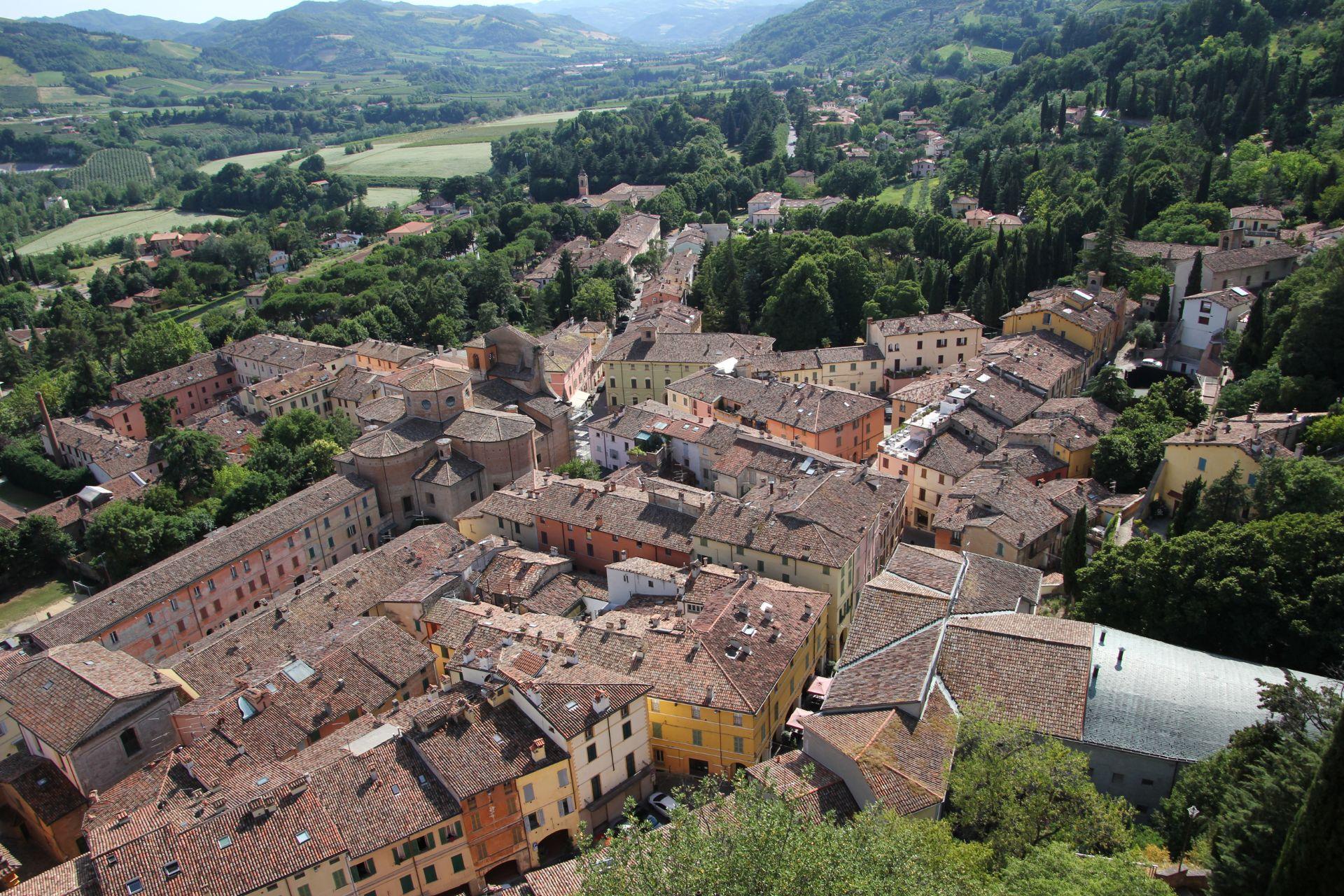
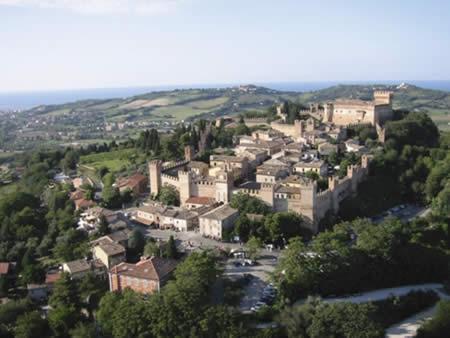
One of the most fascinating examples of the Jewish presence in Romagna is Bertinoro, a splendid medieval village perched on the hills around Forlì and known as the The Balcony of Romagna for the view that stretches across the plain to the Adriatic Sea. Strolling through its narrow cobbled streets, it is easy to be captivated by the timeless atmosphere of the historic centre. Few people realise, however, that right here, as far back as the 14th century, there was a vibrant Jewish community that was fully integrated into city life.
The heart of the Jewish community was the neighbourhood of the Giudecca, which is still recognisable today in the town’s urban layout. Walking amongst the stone houses, one can still sense the medieval layout of the neighbourhood, which retains the understated charm of a place where different cultures have coexisted for centuries. Among the most significant buildings, the so-called Leone Ebreo’s House, dedicated to the famous Renaissance philosopher, physician and man of letters of Portuguese origin, author of the famous Dialogues of Love.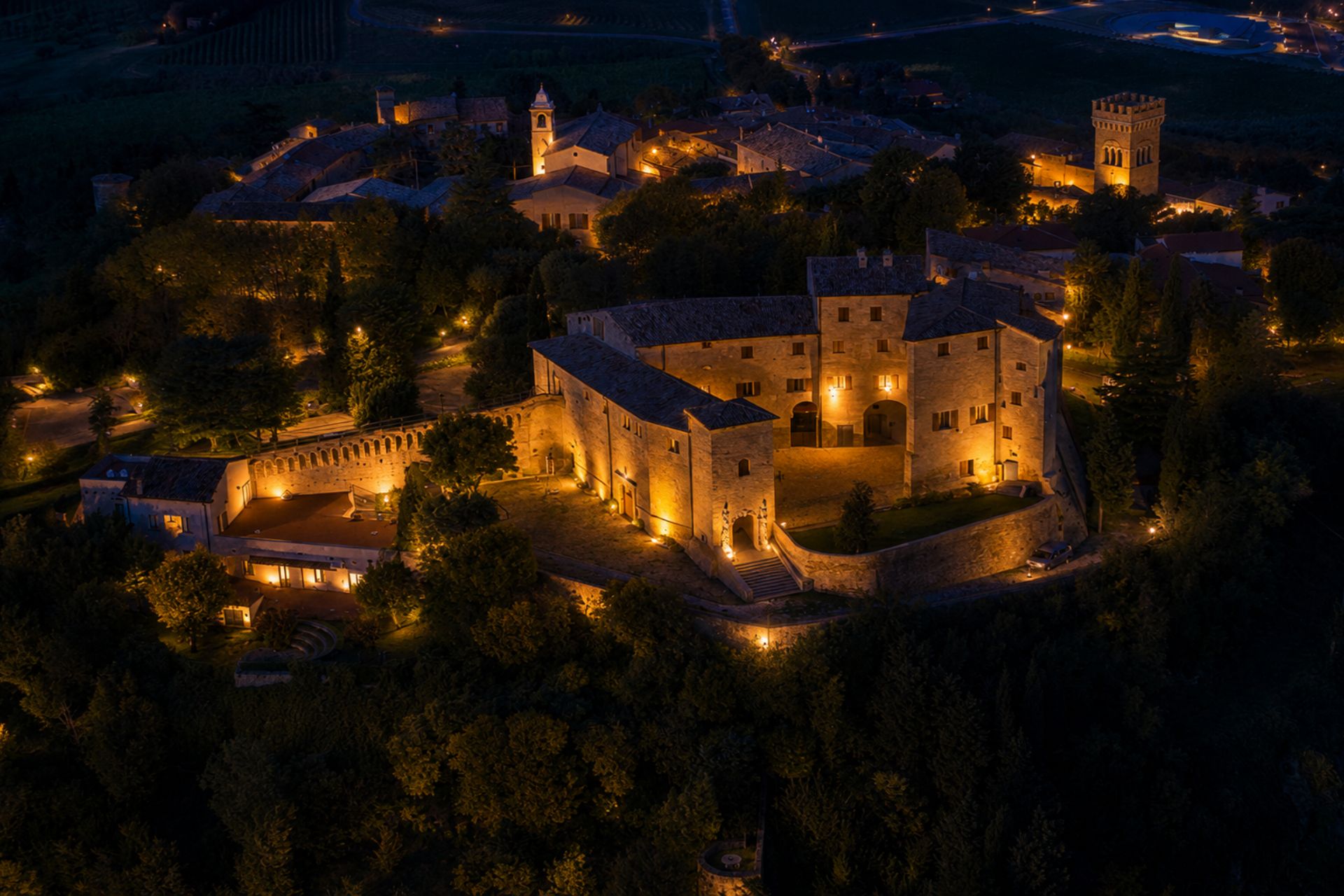
The house is adorned with a commemorative plaque and terracotta decorations featuring symbols from Jewish tradition, such as the Ner Tamid, the eternal light that burns in the synagogues, and the cornucopia, a symbol of prosperity and abundance. A visit to Bertinoro therefore means not only admiring one of the most beautiful villages in Romagna, but also retracing an important chapter in its multicultural history. After exploring the Giudecca, it is lovely to stop in the main square, look out from the famous panoramic balcony and treat yourself to a tasting of local wines.
Lugo: the exquisite collection of stone carvings tells the story of seven centuries
Continuing along the route, you reach Lugo, in the province of Ravenna, a town that preserves one of the most significant examples of the Jewish presence in the whole of Emilia-Romagna. The community in Lugo was among the largest and most active in the region. The earliest documentary evidence dates back to the 13th century and tells of a population engaged primarily in trade, financial activities and the liberal professions.
One of the most valuable artefacts is a gravestone dated 1285, one of the oldest to have been discovered in northern Italy. The place that symbolises the Jewish heritage of Lugo, however, is the Jewish Cemetery, built in 1877 after the previous cemetery was abandoned. As you stroll along the paths, you immediately sense the historical significance of the place, but the real gem is the concise, a collection comprising 34 ancient funerary stelae and three headstones from the old medieval cemetery.
The gravestones, many of which bear perfectly preserved inscriptions in Hebrew, represent an extraordinary artistic as well as historical legacy. Each stone tells the story of families who contributed to the town’s development over the centuries, transforming the cemetery into a veritable open-air museum. For history and archaeology enthusiasts, this is one of the most fascinating sites in the whole of Romagna.
Cento and the ‘vanished’ community
Between Emilia and Romagna lies One hundred, a town that represents one of the most fascinating examples of the preservation of the ancient Jewish urban fabric. The Jewish presence has been documented since at least the 14th century, and for centuries the community was one of the most active in the area, thanks to the town’s strategic location as a crossroads between Ferrara, Bologna and Modena. Over the centuries, the Jewish population contributed to the city’s commercial and financial development, until its gradual decline in the early decades of the 20th century, when the community was incorporated into that of Ferrara.
Even today, you can still stroll through the ancient ghetto, which has recently been restored and retains an extremely charming atmosphere. The dwellings overlook three small interconnected courtyards, creating a unique architectural ensemble. The central courtyard is adorned with elegant 18th-century balconies, whilst passageways had been built within the dwellings to allow the inhabitants to reach the synagogue without having to go outside.
Not far away is the Jewish Cemetery, first documented in the 17th century and rebuilt in its present form in 1818. Strolling through these narrow streets means immersing oneself in a history of coexistence, trade and everyday life, a far cry from the stereotypes often associated with historic ghettos.
Rimini: a community overlooking the sea
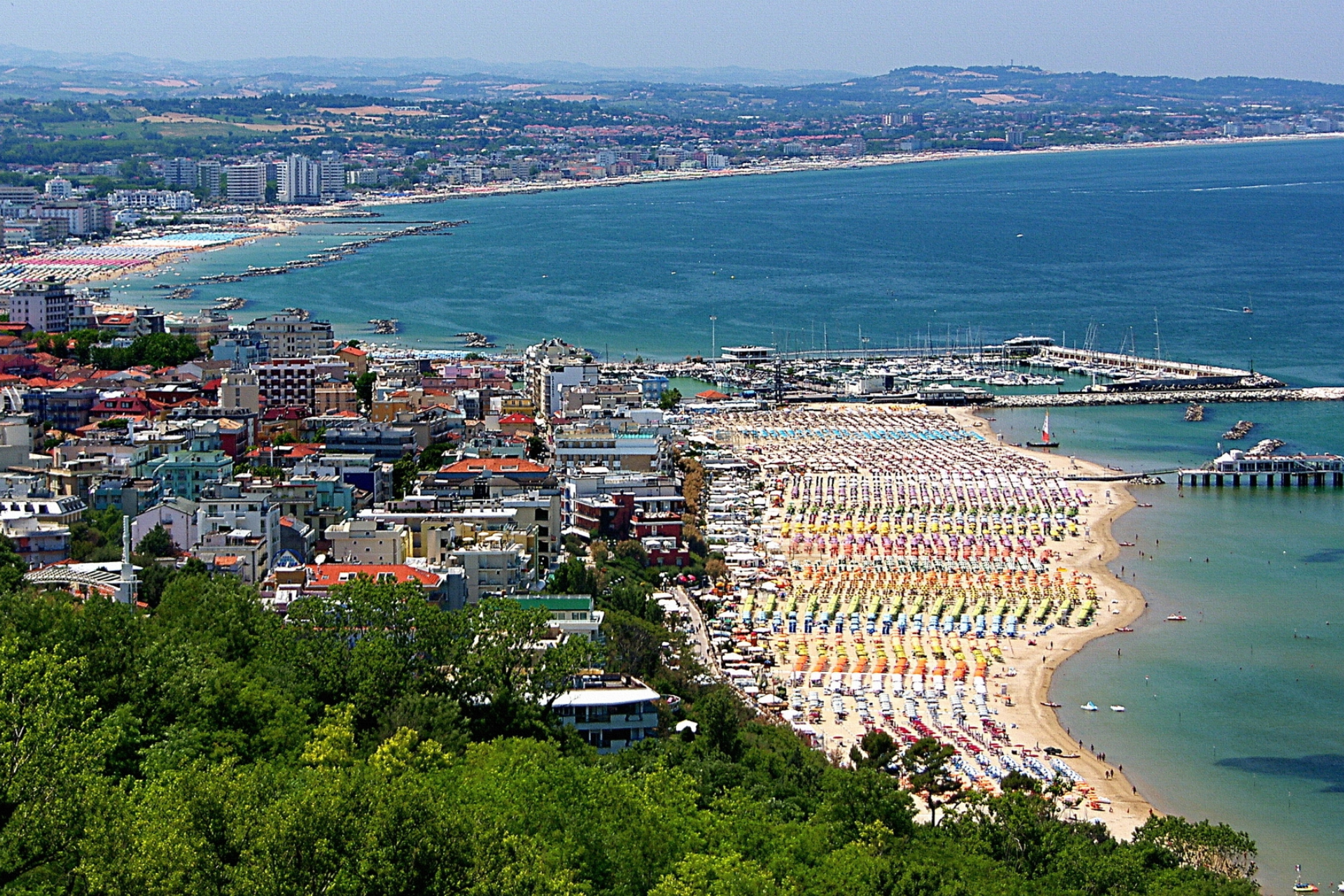
Also Rimini, now a leading seaside resort, retains a past deeply linked to the Jewish community. From as early as the 12th century, the city was one of the main ports on the Adriatic and served as an important meeting point for merchants from Venice, Ancona, Ravenna and the Balkans. Jewish families found here a vibrant environment in which to develop commercial, financial and professional activities.
Doctors, apothecaries and merchants contributed to the city’s growth over several centuries. As was the case in many towns in the Papal States, Rimini, too, gradually saw the freedoms enjoyed by Jewish communities were progressively curtailed, culminating in their expulsion in 1615. Although there are no longer any neighbourhoods today that are as perfectly preserved as those in Ferrara or Cento, numerous documents and studies attest to the presence of a significant community that was an integral part of city life.
Visiting the historic centre with this in mind allows you to discover a side of the city that is often little known, looking beyond the sea and summer tourism. Rimini thus becomes not just a seaside resort, but also a city rich in history, where every era has left a deep mark on the urban fabric and the collective memory.
Ferrara: the heart of Judaism in Emilia-Romagna
Any tour focusing on the region’s Jewish culture simply must end at Ferrara, one of the cities that symbolises Italian Judaism. Thanks to the foresight of the d’Este family, Ferrara welcomed numerous Jewish families from Spain and Portugal during the 15th and 16th centuries, following the expulsions ordered by the Spanish Crown. The city quickly became one of Europe’s most important cultural centres, distinguished by its climate of relative tolerance and the intellectual vibrancy of its communities.
Even today, the Jewish quarter retains its extraordinary charm, with its ancient synagogues, the narrow streets of the ghetto and numerous historic buildings that bear witness to this long-standing presence. A must-see is the National Museum of Italian Judaism and the Holocaust, known as MEIS, a modern museum complex which, through documents, artefacts, multimedia installations and temporary exhibitions, traces over two thousand years of Jewish history in Italy.
A visit to the MEIS perfectly rounds off the Jewish Romagna itinerary, providing the tools to understand the historical and cultural significance of these communities. Ferrara also offers an opportunity to explore the relationship between Jewish identity, the Renaissance city and the memory of the 20th century, making it an essential stop for anyone wishing to engage with the subject with a deeper understanding.
From memory to cultural tourism
Today, these places represent much more than mere reminders of the past. They are stops along a route that offers an insight into a different side of Romagna, characterised by dialogue between cultures, artistic influences and stories that deserve to be passed down through the generations. Medieval villages, ancient ghettos, monumental cemeteries and museums bear witness to a presence that has contributed to the region’s economic and cultural growth for over seven centuries.
Visiting them means rediscovering a heritage that is often little known but of extraordinary value, offering an authentic and deeply meaningful experience. For those staying on the Riviera, this itinerary offers an excellent opportunity to combine a day at the seaside with a day devoted to history and art, exploring towns and villages that preserve some of the most fascinating chapters in the history of Emilia-Romagna.
Recommended itinerary through Jewish Romagna
Anyone wishing to organise a course dedicated to Jewish Romagna You can plan a one- or two-day itinerary, depending on how much time you have. The first day could be spent Bertinoro, including a visit to the Giudecca and the historic centre, before continuing on to Cesena o Forlì to discover other cultural sites in Romagna. The second day could, for example, include Lugo, with its Jewish cemetery and its fine collection of tombstones, and Rimini, where the theme of remembrance can be incorporated into a wider tour of the historic centre.
For those who wish to extend their trip, Ferrara It is the ideal final stop on the itinerary. Its Jewish quarter, historic synagogues and the MEIS allow visitors to link local events to a broader, national and European narrative. It is an itinerary well-suited to those who enjoy slow tourism, history, villages and cultural trails away from the most crowded destinations.
A Romagna waiting to be rediscovered
Hidden behind the Riviera’s landscapes, hills and medieval villages lies a a history shaped by encounters between peoples, cultures and religions. The accounts left by Jewish communities tell us centuries of coexistence, economic growth, cultural output and, sadly, persecution too. Visiting these places means not only learning about a fundamental part of the region’s history, but also reflecting on the value of dialogue, inclusion and remembrance.
Jewish Romagna is a low-key heritage, often little known, yet one that offers visitors a journey rich in emotion, history and beauty. It is an itinerary that invites you to slow down, take in the details and rediscover the area through fresh eyes, off the beaten track yet deeply authentic.