Among the most fascinating remains of medieval Rimini, Porta Galliana It stands as a silent witness to the age-old bond between the city and its harbour.
Built in Two hundred, the gate served as the main link between the walled city and the harbour area along the river Marecchia. It was part of the Frederick’s defensive wall dating from the 13th century, built as part of the urban expansion undertaken during the Swabian period, when Rimini was an important political and commercial centre on the Adriatic.
The new gate replaced an older entrance, situated slightly further in from its current position, and became a strategic point for trade and river defences.
The Malatesta restoration
In Four hundred, Porta Galliana underwent a major restoration project organised by Sigismondo Pandolfo Malatesta (1417–1468), Lord of Rimini and a distinguished patron of the arts.
This has been confirmed by a discovery made in the early 20th century: during some excavations, a collection of Malatesta medals, which Sigismondo had built into the walls of the construction sites of the works he had commissioned or restored as a distinctive mark of his patronage.
Further iconographic evidence of the door can be found in the bas-relief of Agostino di Duccio (1449–1455) housed in the Chapel of the Zodiac Signs of Malatesta Temple.
The artist depicts Porta Galliana itself in the foreground, emphasising its symbolic and architectural significance for Sigismund’s Rimini.
Duccio’s work displays an elegant structure, featuring a round arch and decorations typical of the Renaissance style championed by the Malatesta court.
From the Knights’ Tower to the present day
In 16th century, the gate was closed off and incorporated into a new defensive structure: a tower, documented in the 18th century under the name of “Knights’ Tower”.
The change reflected the gradual relocation of the port and the changing military requirements of the city.
Over the following centuries, the area lost its original function but remained an integral part of the urban fabric linked to the river and the village of San Giuliano.
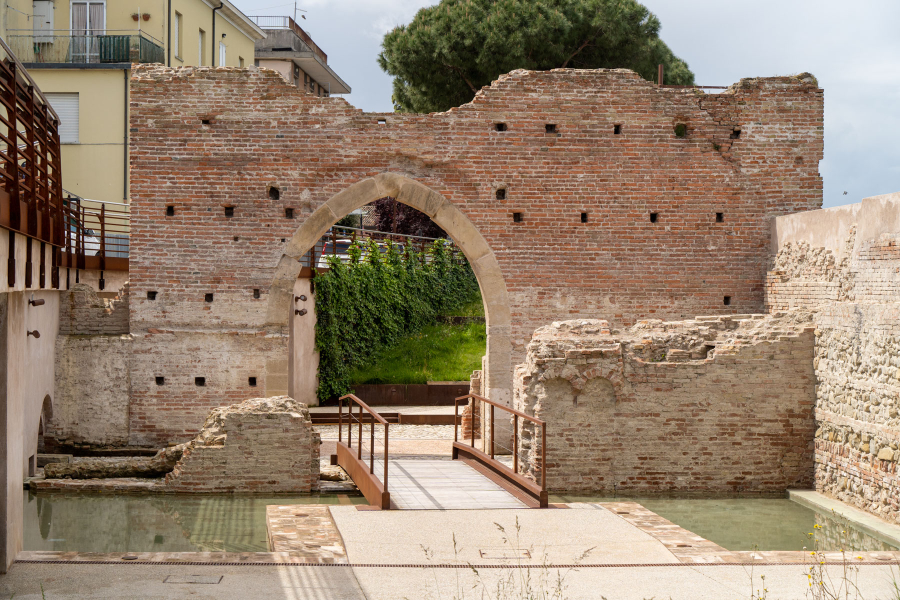
Le recent archaeological investigations have brought to light important information about the structure of the gate and its surroundings: in fact, running through the centre of the arch is a sewer pipe dating from between the 16th and 17th centuries, reflecting the functional evolution of the building over time.
A rediscovered symbol
Today, Porta Galliana has been the subject of recovery and recycling, becoming one of the most evocative places in the Rimini: Underground and Hidden.
Thanks to footbridges and regeneration works, it is possible to admire it up close, in a visual dialogue with the neighbouring Tiberius Bridge and with the waters of the Marecchia, which for centuries served as a natural route for trade, commerce and storytelling.
Once a water gate and a defensive bastion, Porta Galliana remains one of the the most authentic examples of Rimini’s medieval identity, an ideal bridge between the city and its river, between history and memory.