The present-day Piazza Tre Martiri it is situated on the site where it once stood the ancient Roman forum of the colony of Ariminum, the heart political e commercial of the city. This is where the decumanus and the Cardo Massimo: the first, corresponding to today’s Corso d’Augusto, represented the urban extension of the Flaminia Consular Road, by connecting theAugustus Arch at Tiberius Bridge; the second combined Porta Montanara, entrance from the hill, to the coast and the old harbour.
During the Middle Ages, the square, which was then called “Piazza delle Erbe”, was home to the market, the butchers’ shops e jousting tournaments. In 16th century, underwent alterations on the western side which gave it the shape elliptical portico which it still retains today. Further changes took place in the 1921 with the widening of the roads 4 November e Garibaldi, which led to the demolition of theArco dei Magnani.
Throughout history, the square has changed its name several times, from Piazza Grande a Piazza S. Antonio, then Piazza Giulio Cesare, until it became Tre Martiri Square after the World War II, in honour of three partisans - Mario Capelli, Luigi Nicolò e Adelio Pagliarani – executed here on 16 August 1944. A marble inlay marks the point of execution.
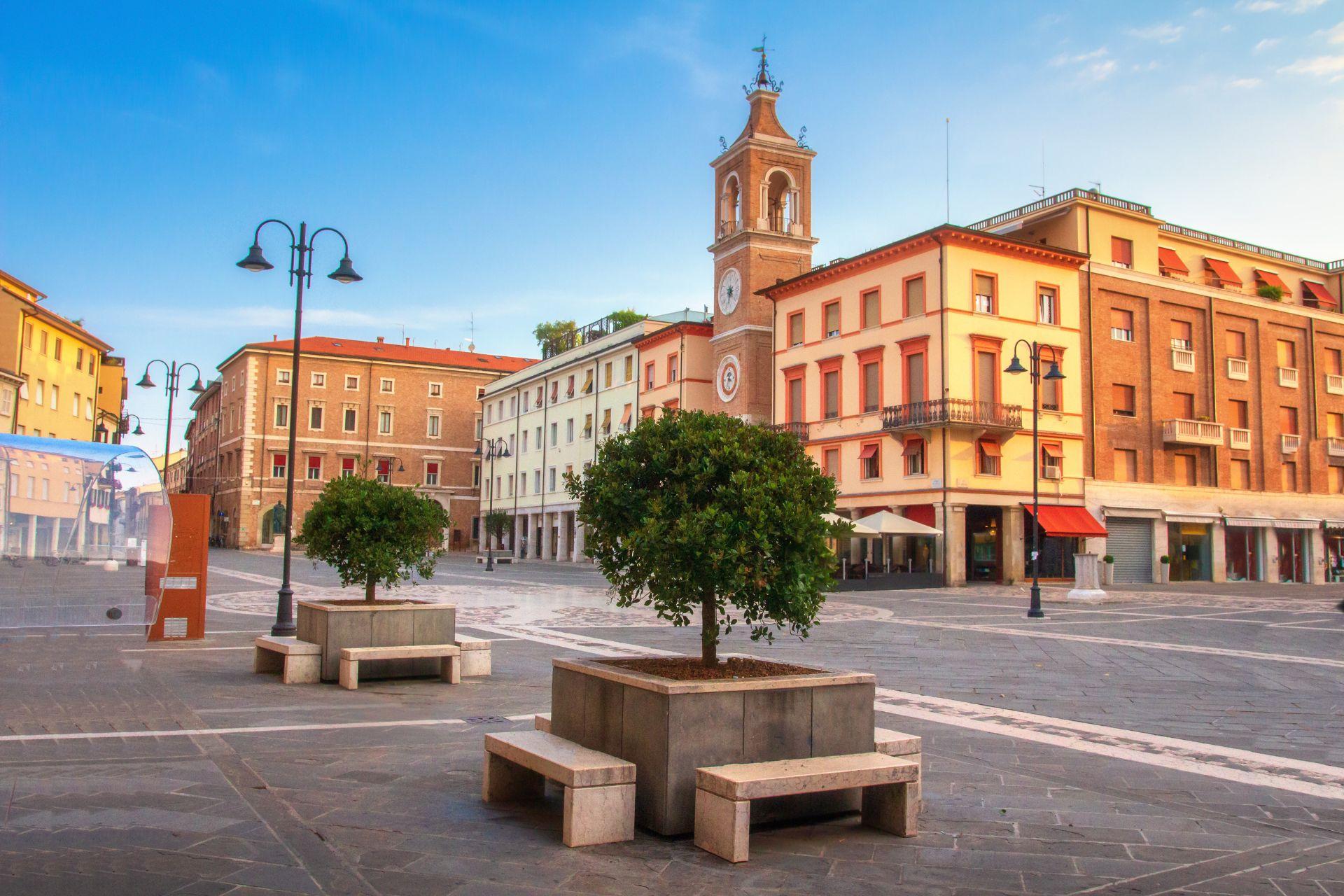
Today, the square is home to a number of buildings modern, the 16th-century Clock Tower, the Church of the Paolottithe The Little Church of St Anthony and the Renaissance memorial stone dedicated to Julius Caesar. The latter commemorates the famous speech that Caesar is said to have delivered to the soldiers of the 13th Legion after the passage of the Rubicon. Above the column, up to the World War II, there was the “Petrone” which Caesar is said to have spoken about, but which has now been lost.
In recent years, the regeneration The square’s redesign has enhanced its appearance, with a paving in materials local such as thesandstone from the Forlì Apennines and the white limestone. In the centre, the junction between the thistle and the decumanus has been highlighted with a Renaissance sun, a symbol taken from the Malatesta Temple and from the watch face.
La Tre Martiri Square it remains the heart to this day button of the city, surrounded by shops, offices, bar e patisseries.
How to get there:
- By car: motorway exit A14 Rimini South, following the signs for the town centre (about 3 km). Recommended car parks: Piazza Ferrari, Tiberius Bridge, Largo Gramsci, Rimini Parking Settebello.
- By train: from railway station, continue along Dante Avenue all the way to the square.
- By plane: bus No. 9, stop Augustus Arch o railway station.