The Malatestiana Library in Cesena: the place where books have been chained up for almost six centuries
There are places that tell a story. And then there are places that seem to have brought history to a standstill.
In the heart of Cesena lies a place unlike any other in the world, where time seems to have stood still in the 15th century: the Malatestiana Library, one of Romagna’s most extraordinary cultural treasures.
Anyone entering the ancient Nuti Lecture Theatre It evokes a feeling that is hard to describe. The columns divide the space into three naves, light filters in through the tall windows, and the books are still there, just as they were placed centuries ago.
No copies. No reconstructions. Authentic manuscripts, still chained to their desks.
A public library founded during the Renaissance
The Malatestiana Library was opened on 15 August 1454 by the will of Malatesta Novello, Lord of Cesena and a man of great learning.
The architectural design was entrusted to Matteo Nuti, a pupil of Leon Battista Alberti. The result was a harmonious, light-filled and functional library, designed not only to house the books but also to make them accessible.
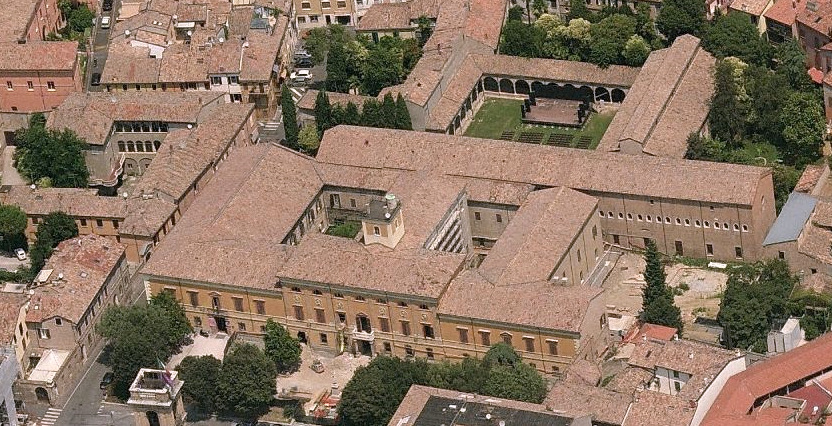
At a time when libraries were often the property of monasteries, royal courts or religious institutions, the Malatestiana represented something revolutionary: a place of learning linked to the city and its community.
Why were the books chained up?
The question naturally springs to mind: why did a public library keep its books chained up with iron chains?
The answer says a great deal about the value of books in the fifteenth century. A manuscript was an extremely rare, expensive and often unique item. Each volume required months of work by copyists, illuminators and craftsmen.
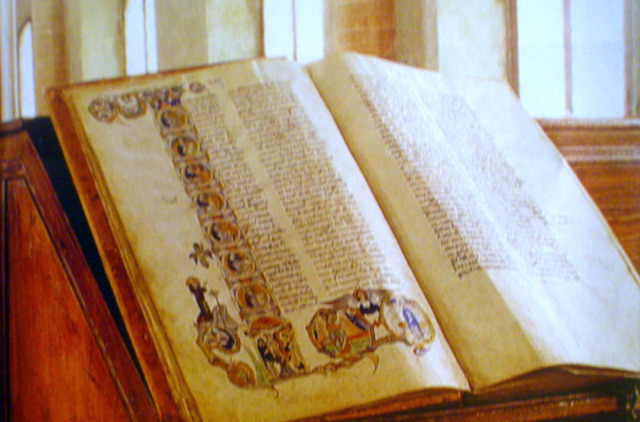
The chains were therefore not a means of restriction, but a system of protection. Readers could consult the codices directly on the plutei, the old wooden desks, without those precious volumes being at risk of disappearing.
It was a way of safeguarding knowledge. A way of making it accessible whilst, at the same time, preserving it for future generations.
The 343 manuscripts are still in their original locations
The greatest marvel of the Malatestiana Library is that its original collection has survived to the present day almost intact.
Even today, the ancient library still houses 343 manuscripts placed on their original plutei and attached to the chains. These include texts on theology, philosophy, medicine, law, literature and the sciences, as well as manuscripts in Latin, Greek and Hebrew.
Malatesta Novello sought to create a collection that would encapsulate the knowledge of his time. A humanist library in which books were not merely sacred objects or symbols of prestige, but tools for civic life.
The Nuti Hall: a journey through the 15th century
Stepping into the Nuti Lecture Theatre means getting a close-up look at how people studied during the Renaissance.
The room is divided into three aisles by elegant columns. The reading desks are neatly arranged along the central space. Natural light illuminates the room with a softness that seems specially designed to enhance the reading experience.
Every detail conveys a specific concept of knowledge: order, proportion, silence, beauty. The Malatestiana is not merely an ancient library, but a place where architecture and knowledge continue to engage in dialogue to this day.
A case that is unique in the world
Many historic libraries have moved to new premises, changed their furnishings or altered their purpose. Others have lost part of their original collection.
The Malatestiana Library, on the other hand, has survived to the present day with remarkable continuity: the building, its furnishings, the plutei and the manuscripts are still those of the fifteenth century.
That is why it is regarded as the only perfectly preserved monastic humanities library in its original state. A rare, precious place, almost suspended in time.
UNESCO recognition
In 2005, the Malatestiana Library was included in the Register Memory of the World by UNESCO, a designation awarded to documentary heritage of universal value.
It is not merely a symbolic award. It is confirmation of the global significance of this place, which captures the relationship between cities, knowledge and memory.
Why visit the Malatestiana Library
Visitors to Romagna often think of the sea, the villages, the cuisine and the hills. But Cesena is home to one of the most fascinating cultural experiences in the whole region.
The Malatestiana Library is perfect for anyone who loves history, art, architecture and authentic places. It is an ideal stop on a cultural tour of Romagna, perhaps combined with a visit to Cesena’s historic centre, the Rocca Malatestiana and the city’s other treasures.
Its strength lies not only in the beauty of its surroundings. It lies in the idea it embodies: knowledge as a common good, to be cherished and shared.
Key information
- Where is it: Cesena, in Emilia-Romagna.
- Opening date: 15 August 1454.
- Founder: Malatesta Novello.
- Architect: Matteo Nuti.
- Historical heritage: 343 manuscripts chained to their original plutei.
- Acknowledgement: Listed on the UNESCO Memory of the World Register since 2005.
- Ideal for: cultural tourism, historical itineraries, weekends in Cesena and trips to explore Romagna.
A place where time has stood still
Standing before the chained manuscripts in the Malatestiana Library, one does not think of a prison. One thinks of just how precious every single page must have been.
In an age when we consume words at a rapid pace and forget almost everything, there is still a place in Cesena where books have not merely been preserved. They have been awaited.
A public library with chained books. A place open to knowledge, yet built to preserve it. And for almost six hundred years, that silence has remained.