
I passatelli I am a dish a symbol of the culinary tradition of central Italy, particularly common in Romagna, in the province of Pesaro and Urbino, in the province of Ancona, in certain parts of Emilia and in the province of Perugia.
This soup, mentioned in Pellegrino Artusi’s famous cookbook, probably originates from the delay, a dish from the Romagna region made with eggs, cheese and breadcrumbs. Passatelli are a further development of this soup, retaining its essential ingredients but shaping them into a distinctive form using a special passatelli mould.
As well as being a traditional peasant comfort food, passatelli are characterised by their versatility: they are typically served in broth, but nowadays they are also available in dry versions, accompanied by more modern seasonings.
How to Make Passatelli
Main ingredients:
- Eggs
- Breadcrumbs
- Grated Parmigiano cheese (or Formaggio di Fossa)
- Nutmeg
- Lemon zest
- Black pepper
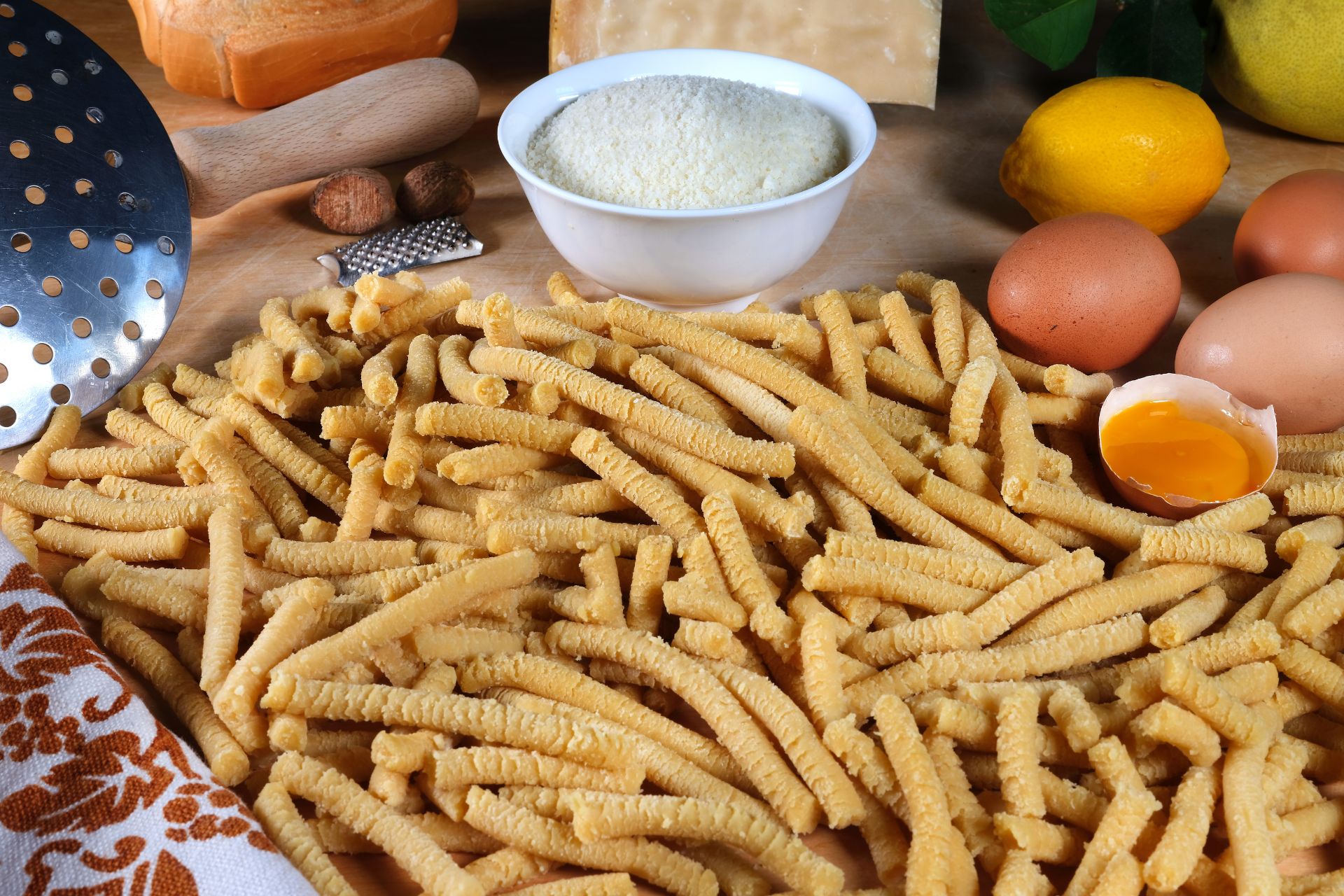
Method:
- Preparing the dough: In a bowl, mix the ingredients together until you have a firm, smooth mixture. The breadcrumbs and cheese form the base of the mixture, whilst the nutmeg, lemon zest and black pepper add aroma and flavour.
- Making passatelli:
- Traditionally, the dough is pressed using a special utensil: the passatelli mould, a perforated metal disc fitted with handles.
- If you don’t have a ‘ferro’, you can use a potato masher with large holes. Although this tool is less traditional, it allows you to make longer passatelli, which are particularly suitable for dry dishes.
- Cooking:
- Passatelli are usually cooked in hot stock. The traditional stock may be made from capon, chicken or beef, whilst more modern variations call for fish stock to accompany seafood dishes.
- They cook quickly: the passatelli are ready when they rise to the surface.
- Modern variants:
- In stock: The classic version, perfect for the winter months.
- Dry: Increasingly popular, dry passatelli lend themselves to creative combinations, such as truffle sauces, porcini mushroom sauces or fish-based sauces.
Note: Compared with a traditional potato masher, the use of a potato press has broadened the versatility of the dish, enabling new culinary interpretations that combine tradition with innovation.