Amidst the orderly fields and straight roads that still characterise the Ravenna plain today, there lies a fascinating itinerary: that of the ancient parish churches of Lower Romagna.
A journey through centuries of history, art and spirituality, tracing the evolution of the region from its early Christian origins in the Early Middle Ages right through to the transformations of the 18th century.
From Byzantine origins to the Christianisation of the countryside
The parish churches of Lower Romagna are the direct successors of the rural Roman life.
They originated between the 6th and 8th centuries, at a time when the Christianity It was becoming firmly established in the daily lives of farming communities, and the collapse of the Roman Empire was paving the way for new forms of territorial organisation.
Originating within the Roman centuriation — traces of which can still be seen today in the regular layout of the roads — the parish churches became the first centres of religious, civil and administrative importance in the countryside.
Equipped with a baptismal font and a cemetery, they served as meeting places for the scattered communities, acting as veritable ‘early forms of local government’.
Over the centuries, as the ecclesiastical structure evolved, their role became predominantly religious, but they always remained places that defined a sense of identity and were centres of deep devotion.
From an architectural point of view, many parish churches still retain the apses facing east, a symbol of Christ rising as the light of the world, and are inspired by Byzantine and Ravenna models, bearing witness to the direct link with the great artistic period of Ravenna, the capital.
A Tour of the Parish Churches of Lower Romagna
A journey that can be completed in a single day, combining spirituality, art and tranquillity, as you visit three places that symbolise this millennia-old heritage.
First stop: Barbiano di Cotignola
Romanesque parish church of St Stephen
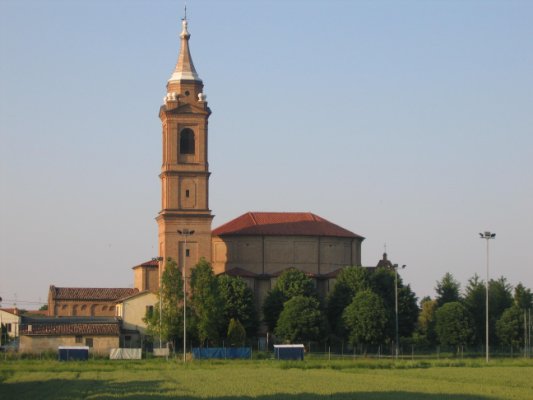
In the heart of the small hamlet of Barbian, stands the Church of St Stephen, one of the most fascinating examples of the local religious heritage.
The present building, constructed in the 18th century to a design by the architect Cosimo Morelli, is characterised by a a simple and harmonious façade, flanked by a slender bell tower that was faithfully rebuilt after the Second World War.
The interior, with a sense of style neoclassical, is striking for its elliptical plan, featuring six chapels separated by elegant Ionic columns that support the large central vault.
But the real treasure lies outside: along the rear edge of the apse, you can still admire the remains of an older Romanesque parish church, dating from the 10th century and subsequently rebuilt before 1409.
The ancient brick wall and the harmonious structure of the apses are reminiscent of typical examples of the Ravenna Romanesque, offering a rare glimpse of medieval sacred architecture set amidst the countryside.
It is as though, behind the neoclassical elegance, the most distant past continues to breathe.
Second stop: Bagnacavallo
Parish Church of St Peter in Sylvis
One of the oldest and best-preserved Romanesque parish churches in the Ravenna area, the Parish Church of St Peter in Sylvis by Bagnacavallo It is a true gem of art and spirituality.
It was built in 7th century, probably on the ruins of an ancient Roman temple dedicated to Jupiter, and is situated in an area which, in late antiquity, was surrounded by woods and marshes (‘in sylvis’, as it were).
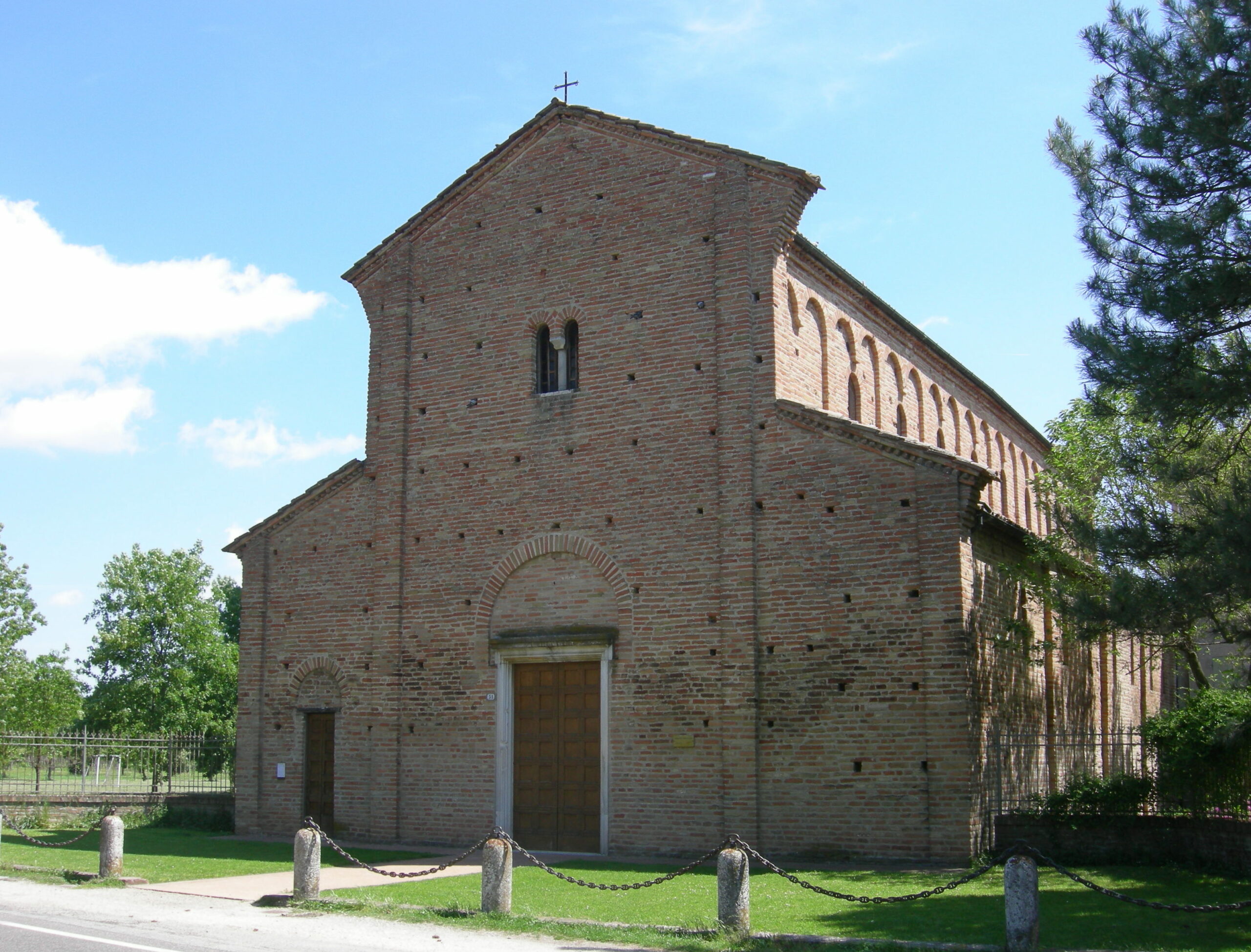
The church was situated along the historic Via dei Romei, one of the main medieval pilgrimage routes to Rome, and for centuries it has served as a place of rest and prayer for travellers.
Inside, it houses a valuable cycle of 14th-century frescoes, attributed to Pietro da Rimini, which depict the the theory of the apostles and the Christ Pantocrator.
The building was once entirely decorated: today, amongst the naves, one can still make out traces of 15th-century paintings from the Ferrara school, ancient coats of arms and a elegant ciborium Romanesque.
Beneath the chancel there is a 11th-century crypt, built using reclaimed Roman materials, which lends the place an almost mystical atmosphere.
The light filtering through the small single-lancet windows and the silence that envelops the space create a sense of suspended time, where one can sense the continuity between faith and time.
Stage 3: Santa Maria in Fabriago di Lugo
Pieve di Campanile
In the area of Lugo, the countryside is home to one of the oldest and most charming parish churches: the Pieve di Campanile, dedicated to Santa Maria in Fabriago.
Its origins date back to theEarly Middle Ages, when it was known as Parish Church of Santa Maria in Centumlicinio.
The current building, at a single nave with a polygonal apse, dates back to the 16th century, but stands on foundations from a much earlier period.
Next to the church stands its most distinctive feature: a cylindrical bell tower dating from the 11th century, built of brick, whose vertical lines are reminiscent of the Ravenna style and invite the visitor to step inside.
The interior, simple and cosy, exudes a deep sense of peace and evokes the religious and cultural roots of the Romagna plain, where faith was closely intertwined with agricultural life and the cycles of nature.
The Pieve di Campanile thus serves as an ideal bridge between the past and the present: a place where medieval spirituality meets the tranquillity of the modern countryside.
A journey into the heart of Lower Romagna
Visit the parish churches of Barbiano, Bagnacavallo and Fabriago means embarking on a journey into the the most authentic record of Romagna, exploring its Christian origins and the physical traces of the Roman centuriation system that still shape the landscape.
Every parish church is a little treasure trove of art and devotion, but also a story of community: a testament to how the countryside has managed to preserve, over the centuries, a balance between humankind, nature and faith.
Practical information
Recommended duration: 1 day
Ideal for: couples, friends, groups, art and history enthusiasts
Recommended time of year: all year round
The parish churches can be visited freely during opening hours or, for groups and guided tours, by booking through the tourist offices at Cotignola, Bagnacavallo and Lugo.
The route can easily be followed by car, motorbike or bicycle, along the country roads linking the three towns.
A journey through art and spirituality
Between Romanesque architecture, medieval frescoes and the tranquillity of the countryside, the ‘Pieve’ trail through Lower Romagna is an invitation to slow down, take in your surroundings and let yourself be enveloped by a heritage that blends stone, light and memory.
A journey out of time, where every east-facing apse still serves as a reminder today of the dawn light, a symbol of rebirth and hope.