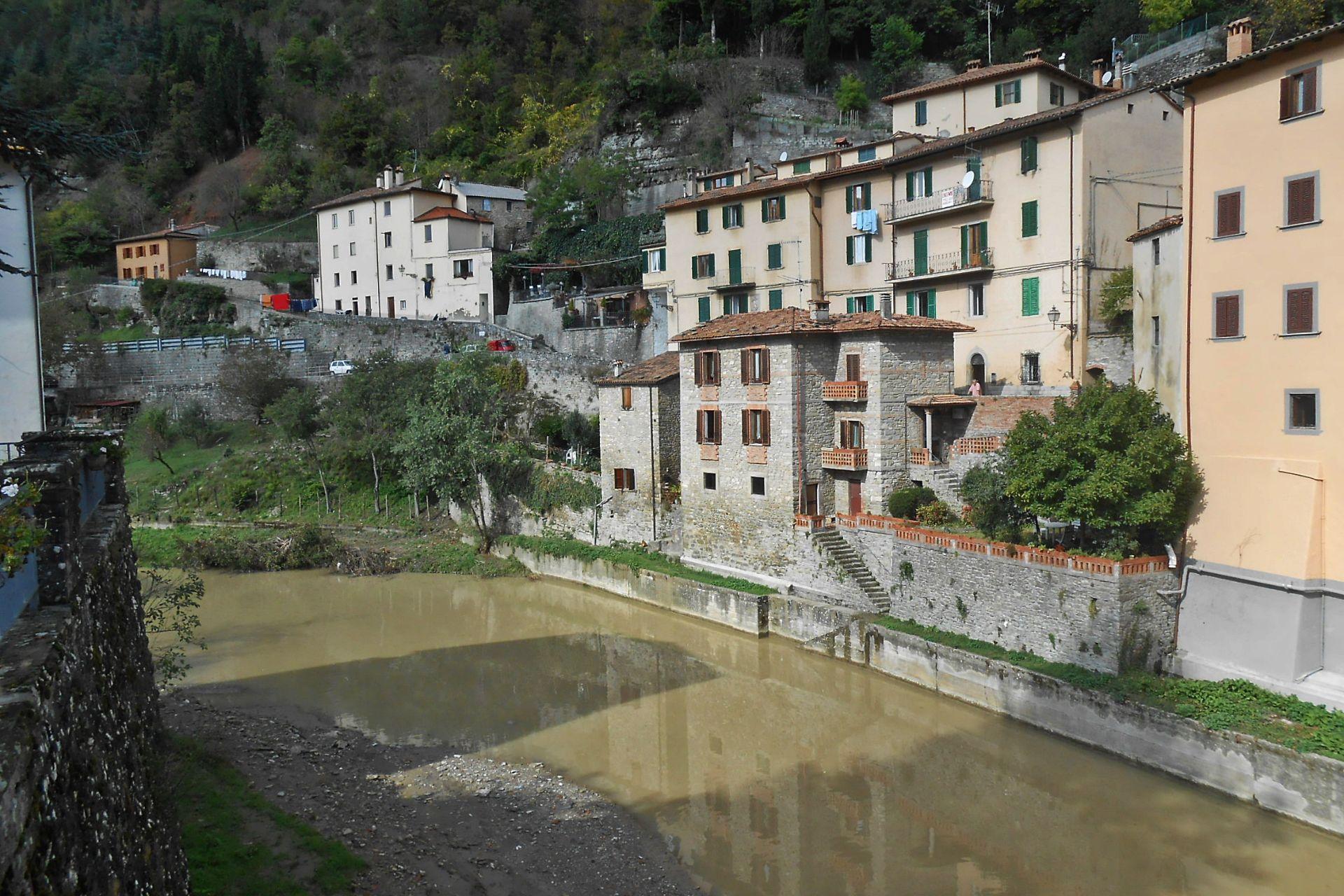
Marradi (pronunciation: /marˈradi/; Maré /ma’re/ in the Romagna dialect) is a Italian municipality with a population of 2,902 inhabitants, situated on the Romagna side of theTuscan-Romagnolo Apennines, but managed by the Metropolitan City of Florence, in Tuscany (also known as Florentine Romagna).
Together with the local authorities of Palazzuolo sul Senio e Firenzuola, Marradi is often mistakenly included in the region of Mugello, under the name of Upper Mugello.
The History of Marradi
The first inhabitants of the area were the Ligurians, the Etruscans and the Galli, whilst the road linking Marradi to the rest of Tuscany and to Florence probably dates back to theRoman era (around the 59 BC).
Originally known as “Castle” (Castellum), Marradi served as a stopping point for travellers. The name ‘Marradi’ derives from “Marrato”, a term meaning ‘ploughed’, referring to a farmstead situated to the right of the the River Lamone.
From the barbarian invasions to feudal rule
Following the invasions of Goths e The Lombards, the territory came under ecclesiastical control. The founding of the main abbeys dates back to this period, including:
- Saint Reparata,
- Santa Maria di Crespino,
- The Camaldolese hermitage of San Giovanni di Valle Acerreta.
From 1164 to 1312, Marradi was a possession of the Conti Guidi, until it came under the rule of the Manfredi of Faenza after a long dispute.
The Battle of Scalelle
In 1358, during the battle “delle Scalelle”, the inhabitants of Marradi rose up against the mercenary company led by Corrado of Württemberg, known as the Count of Landau. Thanks to their thorough knowledge of the area, they managed to scatter the enemy troops, putting an end to the oppression they had endured.
From Florence to the Lorraines
In 1428, Florence defeated Giovanni Manfredi, thereby taking over the entire territory. To celebrate this annexation, a large market is still held in Marradi every Monday morning.
During the government of the Lorena, the area remained isolated due to a lack of infrastructure maintenance. It was only with Peter Leopold of Lorraine A number of major public works were carried out, including:
- La Church of St Lawrence,
- The Teatro degli Animosi,
- A new hospital.
The road linking Faenza to Florence was built in 1883, followed by the railway line in the 1893.
Events of the 20th century
During the The First World War, many people from Marrade fought and 296 of them did not return. Shortly after the end of the war, the 29 June 1919, Marradi was struck by a severe earthquake that caused over 100 victims and destroyed many buildings.
During the The Second World War, Marradi came under heavy bombardment and the 17 July 1944 the following took place: the massacre at Crespino sul Lamone, in which 42 civilians were killed by the Nazis in a reprisal.
The 24 September 1944, Marradi was liberated from the8th Sikh Infantry Division and from the 1st British Division. However, transport links to Faenza remained cut off for three months due to the advance of the front.
Honours
Gold Medal for Civil Merit
Marradi was awarded the Gold Medal for Civil Merit for the courage and dignity shown during the The Second World War. The official statement reads:
‘A small town through which the Gothic Line ran, it endured appalling aerial and ground bombardments with the utmost pride and dignity, suffering the destruction of most of its built-up area and offering, in the cause of the Fatherland and freedom, the heroic sacrifice of forty-two defenceless civilians, slaughtered in an act of reprisal by the Nazi occupying forces.”
- Marradi, summer 1944
The medal was awarded by decree of President of the Republic the 3 July 1991.
Monuments and places of interest
Religious architecture
- Church of Santa Maria Nascente (Crespino on the Lamone)
Founded in 1112, it was incorporated into theVallombrosan Order. - Church of San Ruffillo
Built on a site believed to have been a Vicus Gallanus, that is to say, an ancient settlement of the The Senones Gauls. - Gamogna Hermitage
Founded by Saint Peter Damian, of the monastic complex, the following remain today: cloister, the monks’ cellsthe oven, the drying rooms and the stable. - Abbey of Santa Reparata
First recorded as a Benedictine monastery as early as 1025, he moved on to the 1090 to the Vallombrosan Congregation, which ran it until it was abolished in the 19th century. - Church of St Lawrence (Marradi)
Of Romanesque origin, it was completely rebuilt in the style of neoclassical at 1785.
Civil architecture
- Town Hall (14th century)
A former administrative headquarters, it is one of Marradi’s most significant historic buildings. - Palazzo Fabbroni
A historic residential building of great local significance. - Teatro degli Animosi
A stylish theatre neoclassical, a symbol of cultural life in Marradi. - Palazzo Torriani
A prestigious historic residence, a fine example of stately architecture. - Villa built by the Fabbroni family in Archiroli
An elegant villa set in picturesque countryside. - Villa Piani al Poggio
A splendid villa overlooking the surrounding countryside, a fine example of Tuscan architecture.
Culture
Museums and the Municipal Library
- Campaniani Research Centre
It is home to the Artists’ Museum for Dino Campana, opened in 2009, featuring a collection of works inspired by the writings of the poet Dino Campana, created by Italian and international artists. - Centre for the Study and Documentation of the Chestnut Tree (CSDC)
It includes an exhibition area dedicated to chestnut and its history. - Permanent exhibition of works by Francesco Galeotti
Opened in the autumn of 2012, exhibits works by the local painter. - Municipal Library
Established in 1991, serves as a cultural landmark for the town’s residents. - Marradi Free News
Online newspaper founded in 2010 and edited by Raffaella Ridolfi, it is a source of local news.
Kitchen
The Marron Buono
Marradi is famous for its production of Marron Buono (brand PGI), with extensive chestnut groves in the area. To promote this product, the The Mugello Chestnut Trail in Marradi. The local cuisine is full of chestnut-based specialities, including the famous Marradi chestnut cake.
Events
- Dino Campana Commemoration
Every 20 August, Marradi is celebrating the poet Dino Campana with events dedicated to his life and work. - Chestnut Festival
It takes place every Sunday in October and celebrates the Marron Buono and the typical produce of the autumn season.