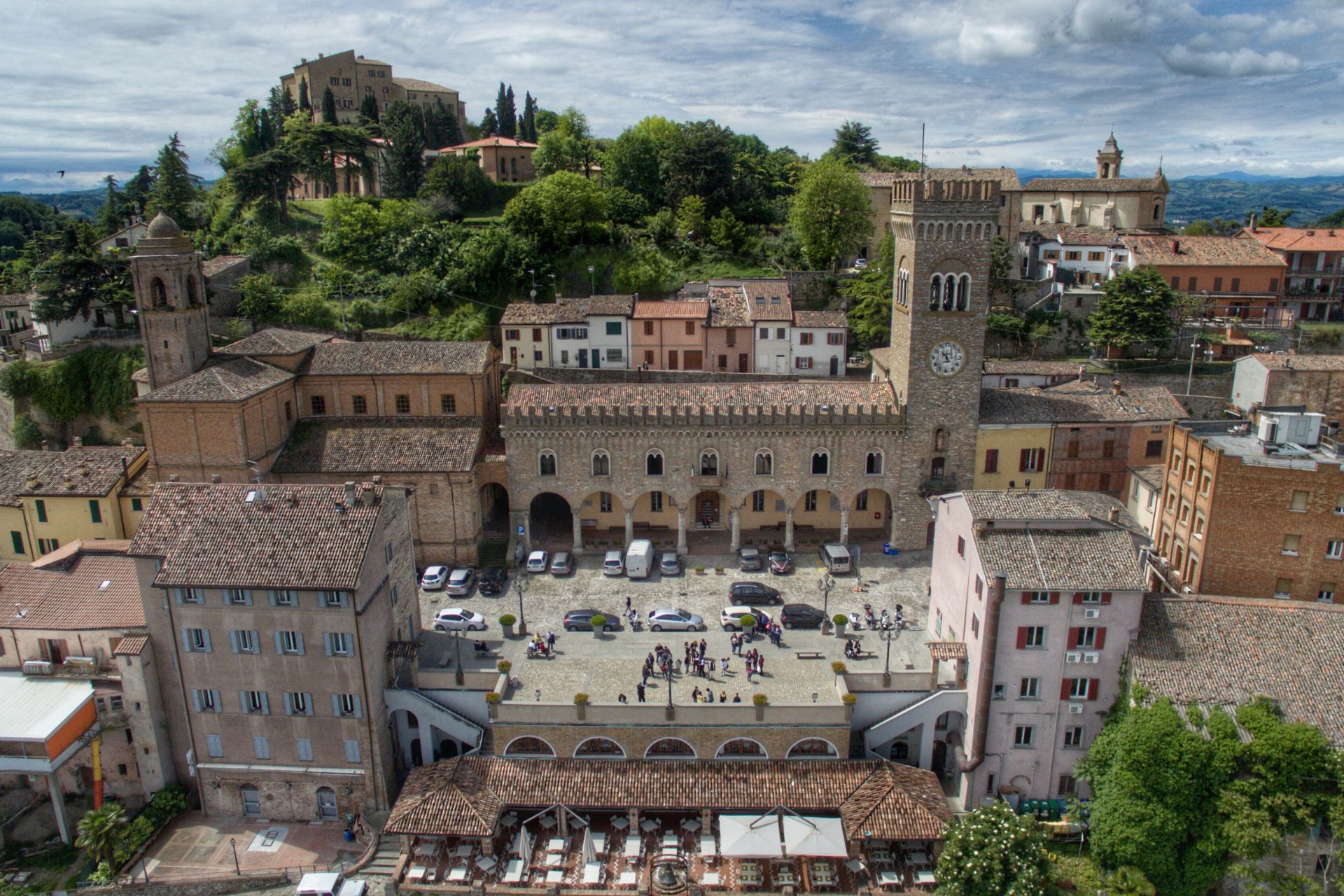
Nestled amongst the rolling hills of Romagna, Bertinoro stands out as a medieval gem, suspended between history and legend. Here, amidst the scents of vineyards e olive groves, the view stretches out from the summit of the Mount Cesubeo, taking in the landscape as far as the Adriatic Sea. It is a place where the time passes more slowly, lulled by the song of the wind among the cypress trees and the warmth of the sun caressing the ancient stones of the houses.
Le cobbled streets The village’s streets invite you to take a leisurely stroll amongst artisan workshops, cosy pubs and scenes that look as though they’ve come straight out of a postcard. Every corner tells a story: a flower-filled balcony hides the memory of a love from afar, a wooden door conceals the family secrets which took place centuries ago, whilst the view from the main square It takes your breath away, offering a view that takes in the whole of the Romagna.
A name, a story
The origin of the name Bertinoro is wrapped in the mystery, which has always added to the village’s charm. Some historians suggest that it derives from the Britti, monks from the Brittany who, perhaps, found refuge in its hills. Others link it to an ancient nobleman named Berto o Brictus, whose name is said to have evolved over time into Bertinoro.
But the caption The most fascinating is the one linked to theEmpress Galla Placidia. It is said that, whilst tasting the local wine, she found it so delicious that she exclaimed: “It deserves to be drunk in gold cups, ‘not terracotta!’. Ever since then, the wine from Bertinoro he became famous as the “Berto’s wine”, giving rise to the village’s name.
From fortresses to counts: the Middle Ages in Bertinoro
The beating heart of the village is the majestic fortress, built around thethe year 1000, which overlooks the summit of the Mount Cesubeo like a silent sentinel. From his crenellated walls you can enjoy a breathtaking view which extends as far as the the Apennine Mountains and the Adriatic Sea. In its long corridors and ancient halls, one can still almost hear theecho of voices of the counts and knights who lived there centuries ago.
In 1177, the Rocca welcomed Frederick Barbarossa, Emperor of the Holy Roman Empire, during his visit to Italy. In the centuries that followed, the fortress became the scene of intrigues, sieges and alliances, coming under the control of powerful families such as the Sforza and the Borgia. Every stone in the castle tells a story: from the battles fought beneath its walls, to the lavish banquets organised to celebrate victories and noble weddings.
Places of faith and beauty
Bertinoro It is also a place of deep spiritualitywith churches e parish churches which tell the story of the deep-rooted faith of these lands. The Co-Cathedral of St Catherine dominates the main square with its elegant stone façade. Inside, the silence and the soft light create a peaceful atmosphere, whilst priceless works of art tell stories of saints and martyrs. Of all of them, one stands out: a 16th-century wooden crucifix, a testament to centuries of devotion.
But the true spiritual treasure of Bertinoro It is situated just outside the village: the Parish Church of San Donato in Polenta. Dating from the end of the 9th century, this ancient church is a rare example of Romanesque architecture. Her columns and capitals they talk about times long past, whilst the small cemetery next to it houses forgotten stories of pilgrims and the faithful. Giosuè Carducci, one of Italy’s greatest poets, celebrated its beauty in his poem “The Church of Polenta”, making it immortal in literature.
Hospitality and traditions
Bertinoro It is known as the “The Balcony of Romagna”, but it could also be described as the “Village of Hospitality”. Here, thereception It’s not just a tradition: it’s a lifestyle. La Column of the Rings, the symbol of the village, tells this story secular vocation. Each ring represented a family from the village, ready to welcome travellers and strangers.
This tradition is revived every year during the Festival of Hospitality, an event that transforms the village into a open-air theatre. The streets and squares come alive with music, shows and banquets under the stars, where people raise a glass to the local wine and you can sample the specialities of Romagna cuisine. It is an experience that goes beyond a mere celebration: it is an invitation to feel part of a community.
The Fratta Thermal Baths: a gift from the earth
A few kilometres from Bertinoro, the Fratta Thermal Baths represent aoasis of wellbeing nestled in the nature. Already known in Roman era, the spring water in this area are famous for their healing properties. Rich in minerals as sulphur, magnesium and bicarbonate, are used for rejuvenating treatments and therapeutic.
Strolling amongst the trails in the spa park, you can immerse yourself in an atmosphere relaxing, surrounded by the green and the sound of running water. The the springs of Panighina and the Rio Salso invite you to discover the Secrets of the Underworld, offering a moment of rejuvenation for the body and spirit.