Situated at a height of approximately 18 metres above sea level, Barbian (in Romagnolo Barbiân) is a hamlet of Cotignola, in the province of Ravenna, with a population of around 1,300 inhabitants. This small farming village in the Lower Romagna It is best known for being the birthplace of the famous Alberico da Barbiano, captain of the Ventura (1349–1409), a historical figure of great importance in medieval Italy.
Origins and name
The origin of the place name ‘Barbiano’ is a matter of debate: according to some scholars, it may derive from the the Balbia family, an ancient Roman patrician family said to have settled in this area. Although this theory is an intriguing one, it is not supported by reliable sources.
History
Antiquity and the Early Middle Ages
According to a legend recounted by Girolamo Bonoli, Barbiano is said to date back to before the829, with an alleged deed of donation of the land by Everardo, son of the Lombard king Desire, to Abbess Agata of the Monastery of San Vincenzo in Milan. However, this document has been lost and the veracity of the account is doubtful.
The first ones documented historical sources date back to 14 November 950, in a document which refers to the Parish Church of St Stephen as “plebs sancti Stephani quae vocatur in Barbiano”. The same expression appears again in 993. At that time, the parish had spiritual and baptismal jurisdiction across a vast area, including Lugo e Fusignano.
The Late Middle Ages and the da Barbiano family
The Middle Ages Barbiano is inextricably linked to the powerful family of the from Barbiano, Counts of Cunio, who transformed the village into a fortified castle. Among the leading figures, one stands out Alberico of Barbiano, regarded as one of the greatest military commanders of his time.
In 1338, Manfredo of Barbiano he reclaimed Lugo with the help of the Archbishop of Ravenna, subsequently handing it over to Taddeo Pepoli. But in the 1352, the town finally passed into the hands of the Visconti.
The Barbiano Castle was destroyed in 1409 from Lodovico da Barbiano, the wayward son of Alberico, an ally of the cardinal Baldassarre Cossa. Following the destruction, Lodovico assumed the title of count and gained control of Lugo, Massa Lombarda e Conselice.
In 1436, the da Barbiano family moved permanently to Lombardy, taking the title of the Counts of Belgioioso, whilst retaining the honorary reference to Cunio.
Modern and Contemporary History
From 15th century, Barbiano came under the control of the Sforza and then some Este. In 1598, was annexed to the Papal State, under which it remained (apart from the Napoleonic period) until theUnification of Italy.
During thethe Napoleonic invasion of 1796, Barbiano was involved in the the crackdown following the Lugo uprising, due to the involvement of some of its inhabitants in the ambush at Villa Bolis.
In the first half of theNineteenth century, two local figures – Pietro Tasselli e Andrea Montanari – they joined the gang of the famous Stefano Pelloni, known as The Smuggler, helping to link Barbiano to the history of brigandage in the Romagna region.
The 20th and 21st centuries
During the World War II, the Allies’ advance came to a halt along the the River Senio. Barbiano was liberated during the night of 9–10 April 1945 from 24th Infantry Battalion of the 2nd New Zealand Division.
A significant episode linked to the conflict concerns Giovanni Camerini, a young man from Barbiano who was killed whilst the Italian army’s final cavalry charge, on the Yugoslav front, the 17 October 1942.
In the post-war period, Barbiano saw development in its services and infrastructure: the railway station (1955), and essential services such as the nursery school, the primary school, a post office and one pharmacy. Furthermore, there is a production plant belonging to the agri-food consortium in the area Conserve Italia.
Monuments and places of interest
Parish Church of St Stephen
Founded before the 10th century, the Parish Church of St Stephen For centuries, it has been the religious and cultural heart of Barbiano. The present building, in Romanesque style, it was rebuilt around 1447. It survived both the destruction of the castle in 1409 and the Second World War air raids. It is listed amongst the monumental buildings recognised by the Province of Ravenna.
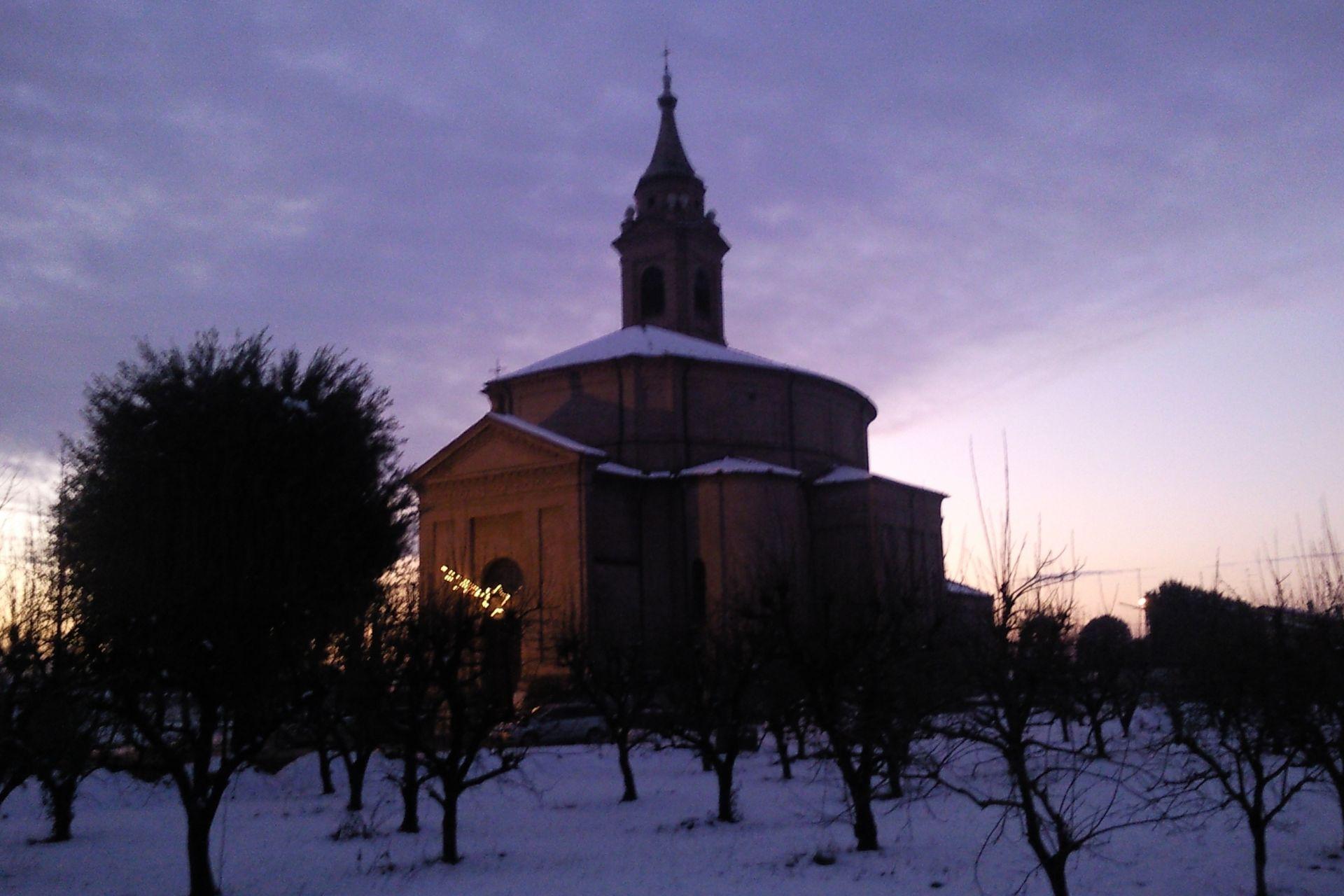
Church of St Stephen the Protomartyr
Built in 1784 designed by architect Cosimo Morelli, was faithfully rebuilt after the war, together with the bell tower, which, with its 47.5 metres It is one of the tallest in the area. The church houses the image of the The Crowned Madonna, revered by the community.
Culture and traditions
Feast of Our Lady of the Crown
The the first Sunday in September and it is the religious festival most cherished by the Barbiano community, featuring liturgical celebrations and cultural events.
The patron saint
The patron saint of Barbiano è Saint Stephen the Protomartyr, celebrated on 26 December.
Literature
I from Barbiano, in the form of the the lords of Cunio, are mentioned by Dante Alighieri at Canto XIV of Purgatory, amongst the envious.
Infrastructure and transport
Barbiano is situated along the county road which connects Lugo a Faenza and is served by the Castel Bolognese–Ravenna railway line.
La Barbiano railway station, which opened in 1955, provides connections to the main towns in Romagna, ensuring that the hamlet is well integrated into the regional transport network.
Curiosity and identity
On the façade of the town hall the following is visible: historic coat of arms in Barbiano, a symbol of the continuity between medieval heritage and present-day identity. The hamlet still preserves a a strong sense of community, supported by a vibrant network of local organisations and through active participation in religious and folk traditions.
Barbiano is a small town that combines the the value of historical memory to a a vibrant and well-connected area, offering an authentic insight into the Rural Romagna and its cultural heritage.