A journey through history, art and spirituality in the heart of Dante’s city
In the heart of the historic centre of Ravenna, nestled in the picturesque Zone of Silence and just a stone’s throw from Dante’s Tomb stands one of the churches most cherished by the people of Ravenna: the Basilica of St Francis. A treasure trove of art, spirituality and memories of Dante, the basilica is an iconic place that combines the charm of the past with a strong religious and cultural identity.
Origins and history
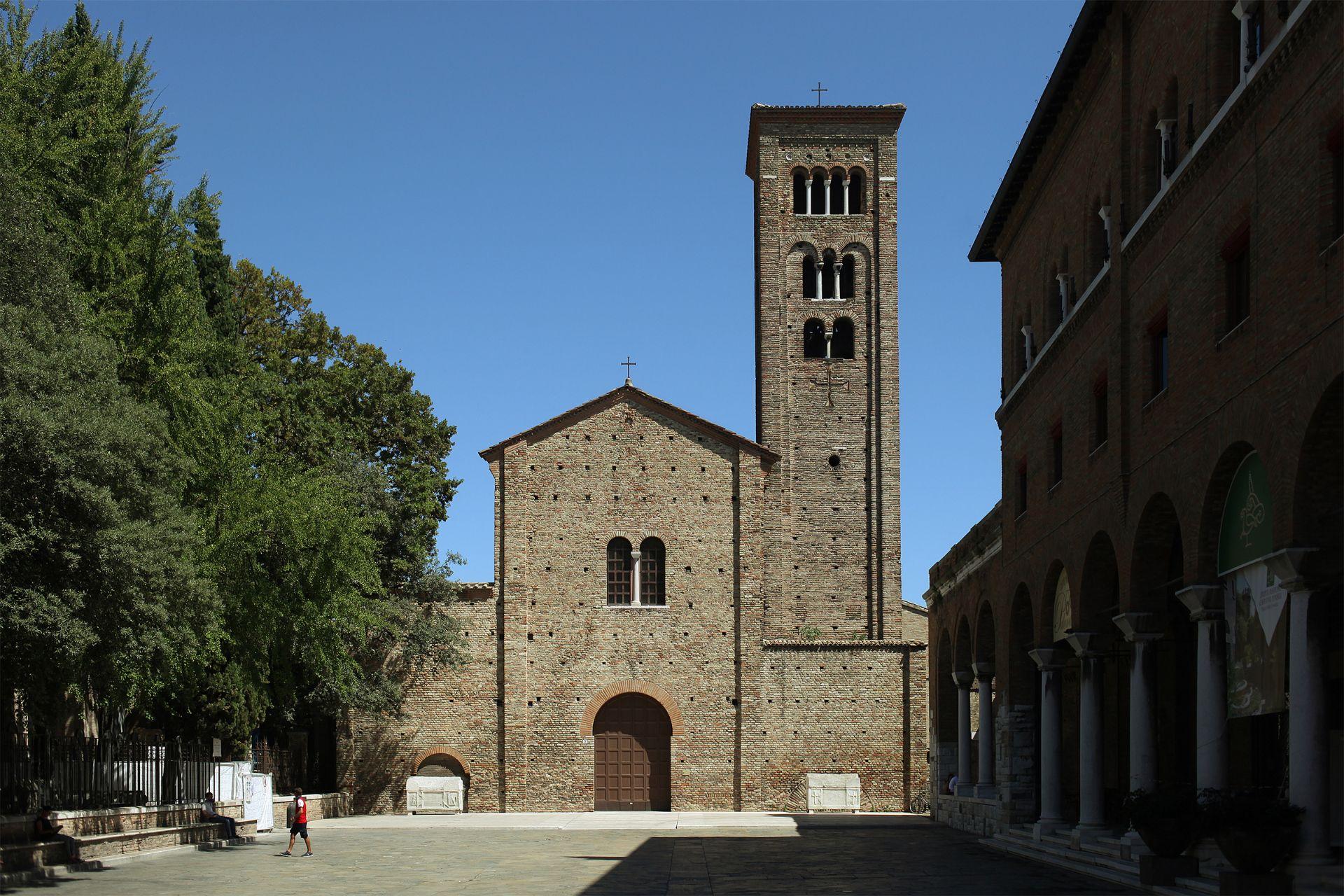
The present-day basilica stands on the site of an earlier early Christian church commissioned by the bishop Neon around the middle of the 5th century AD and dedicated to Saints Peter and Paul, the Apostles. In the 9th century, a new Romanesque-style building was erected on those foundations, together with the bell tower, which can still be seen next to the façade.
In 1261, the church was entrusted to theOrder of Friars Minor Conventual, who named it after St Francis of Assisi, turning it into their spiritual centre in Ravenna. It was here that, in September 1321, the solemn funeral of Dante Alighieri, who had found refuge with the Da Polenta family. The poet was temporarily buried in the family chapel, along the left aisle of the basilica, in a precious 4th-century sarcophagus.
The submerged crypt
One of the most striking features of the basilica is its crypt, dating from the 9th–10th centuries and situated beneath the chancel. Accessible via a double flight of stairs and also visible through a small arched window, the crypt takes the form of a three-nave oratory with cross vaults, supported by small columns with geometric capitals.
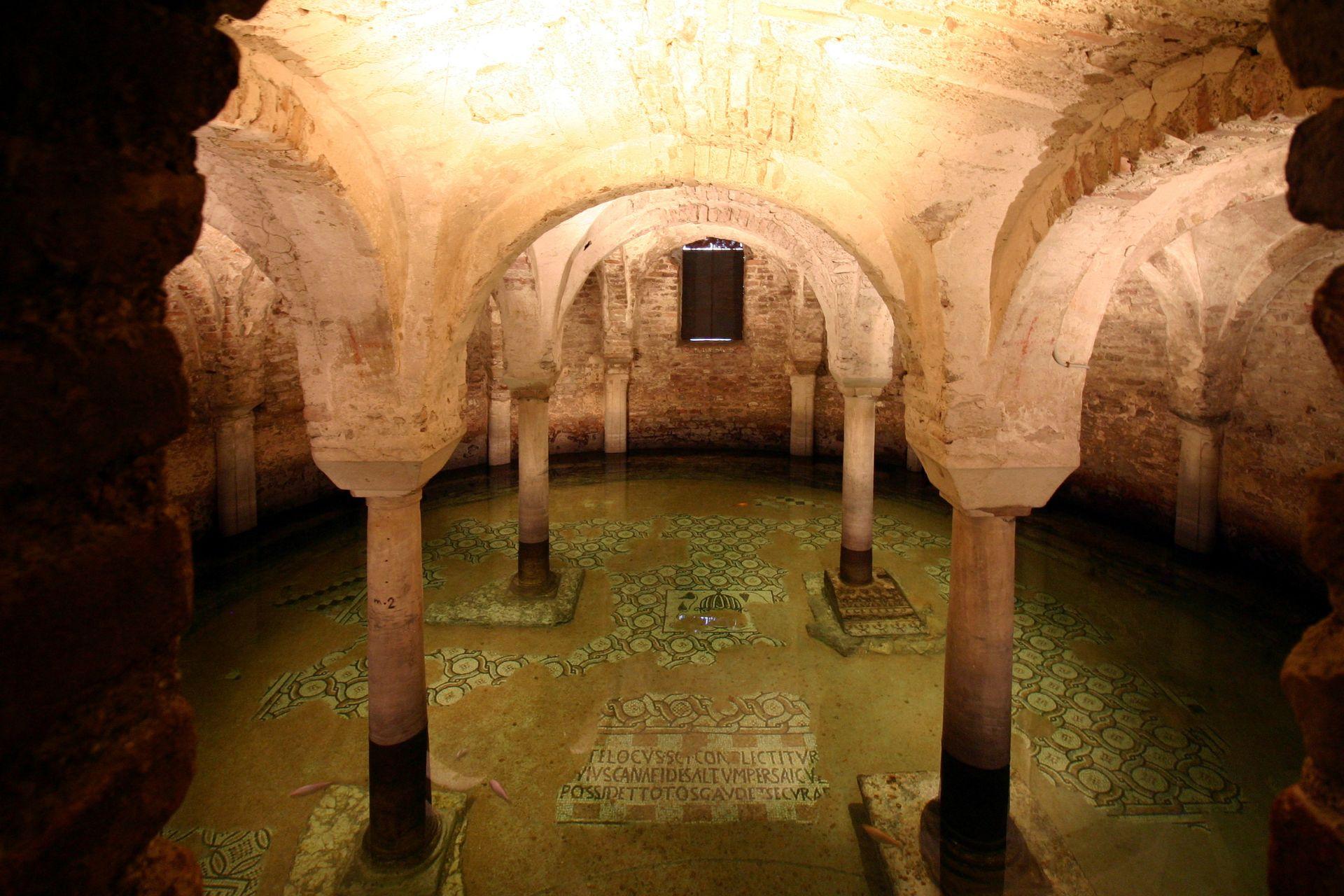
The mosaic floor, dating from the 5th century, is completely submerged by groundwater, which seeps gently from the ground. The presence of goldfish The fish swimming peacefully amongst the mosaic fragments lend an almost surreal touch to the visit. Two mosaic inscriptions, one in Greek and the other in Latin, commemorate the donors Esichio and Gemella, and the burial of the bishop, respectively Neon, the founder of the early church.
The bishop’s marble sarcophagus can still be found today near the crypt, bearing witness to the pivotal role he played in the Christian community of Ravenna.
Architecture and interiors
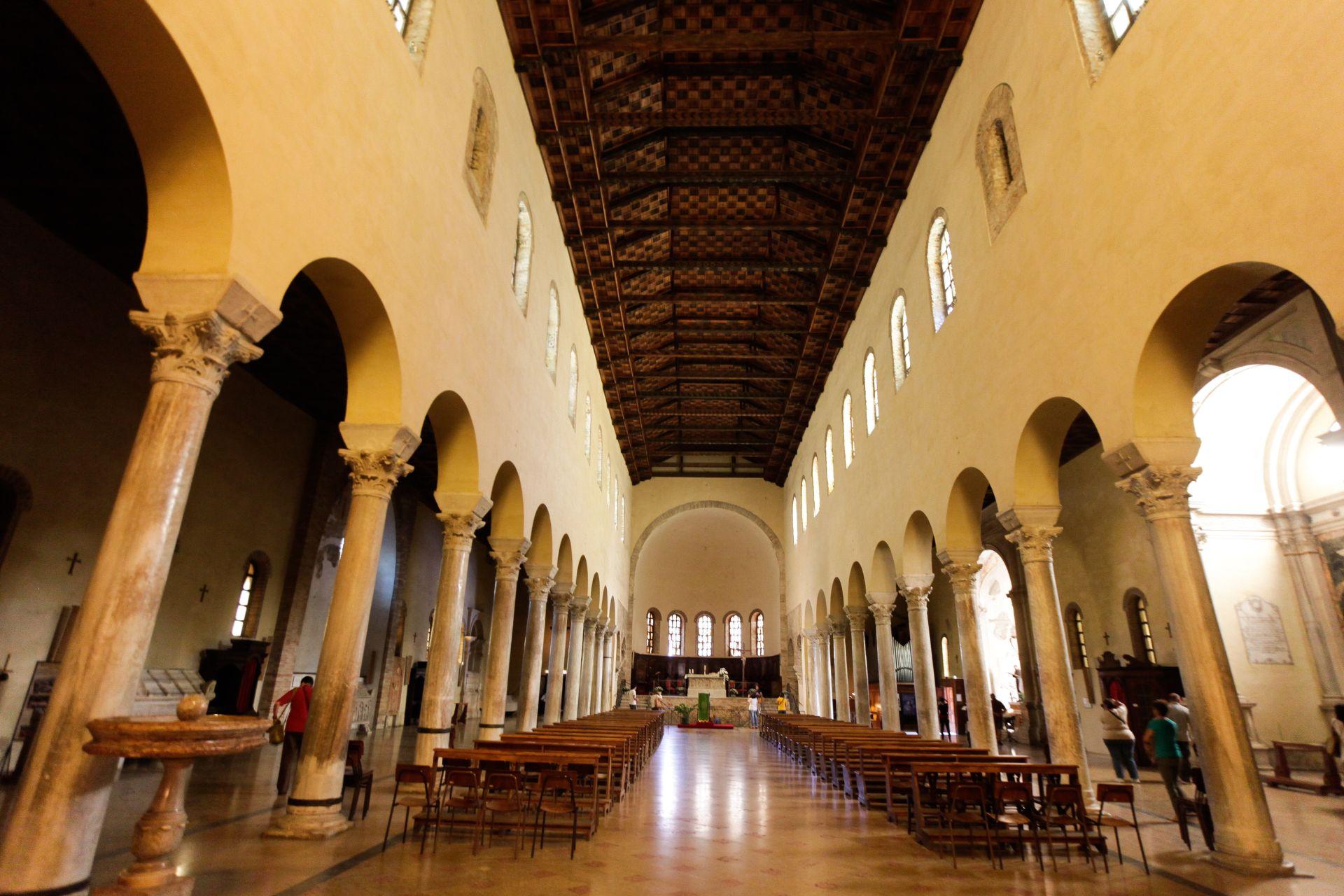
La façade The basilica, simple and harmonious, is built of exposed brick and features an arched portal surmounted by a mullioned window. On either side stand two ancient Roman sarcophagi. The interior follows a classic basilica layout with three naves, separated by two rows of twelve reused columns with round arches.
Particularly fascinating is theapse: semi-circular on the inside and heptagonal on the outside, it now appears noticeably lower due to subsidence. The high altar is constructed from a 5th-century sarcophagus attributed to the bishop Liberius III, adorned with five figures carved within arches supported by fluted columns. Behind it stands a fine carved wooden choir.
The side chapels and the works of art
Along the right-hand aisle are three chapels dating from the 16th century. Of particular note is the first one, which originally housed the famous reclining statue of Guidarello Guidarelli, sculpted by Tullio Lombardo and now housed at the MAR – Ravenna City Art Museum. The third chapel, on the other hand, is adorned with a dome decorated with frescoes by Andrea Barbiani and features a painting by Gaspare Sacchi depicting the Virgin and Child and various saints.
A spiritual and cultural symbol
Over the centuries, the Basilica of St Francis has undergone numerous restoration works. The most significant of these took place between 1918 and 1921, to mark the 600th anniversary of Dante’s death. On that occasion, the Baroque additions were removed to restore the church to its austere Romanesque elegance, more in keeping with Franciscan spirituality.
I Friars Minor Conventual They returned in 1949, settling in new premises next to the basilica. The building still stands today parish office and one of the city’s most significant places of worship, a landmark for both the faithful and the many tourists drawn by the figure of Dante and the city’s artistic heritage.
A visit to the Basilica
The Basilica of St Francis is open to the public and is open to visitors all year round. Its quiet charm, the play of light on the water in the crypt, its spiritual depth and its connection with the Supreme Poet make every visit an unforgettable experience.
Useful information
📍 Address: Piazza San Francesco, Ravenna
🕍 Architectural style: Early Romanesque
🎯 Point of interest: Dante’s Area, Submerged Crypt, Mosaics
🎫 Access: Open, except on days of religious observance
📷 Recommended for: art lovers, history buffs, Dante trails
A place where time seems to have stood still, amidst submerged mosaics, echoes of Dante and Franciscan spirituality.