La Basilica of Sant’Agata Maggiore It is one of the oldest churches in Ravenna, situated in the heart of the historic centre, a short distance from the Basilica of St Francis and from the Dante Alighieri’s Tomb. The building dates back to 5th century, but its current appearance is the result of restoration work carried out in the early 20th century, which restored the simple and solemn lines of the original architecture early Christian.
History
The basilica is named after “Maggiore” to distinguish it from the other two medieval churches in Ravenna dedicated to Saint Agatha. It was founded in the 5th century along the route of the ancient the River Padenna, which no longer exists, and which used to run where it now stands Via Mazzini. The building is situated within the context late antiquity and is commonly attributed to the Bishop John I (477–494), even though the monogram The one in the central nave refers to the successor Peter II (494–519), a sign that the work may continue. Theapse, on the other hand, may have been completed later, under the Bishop Agnello (556–569), with the financial support of Giuliano Argentario, a renowned benefactor of the Basilica of San Vitale.
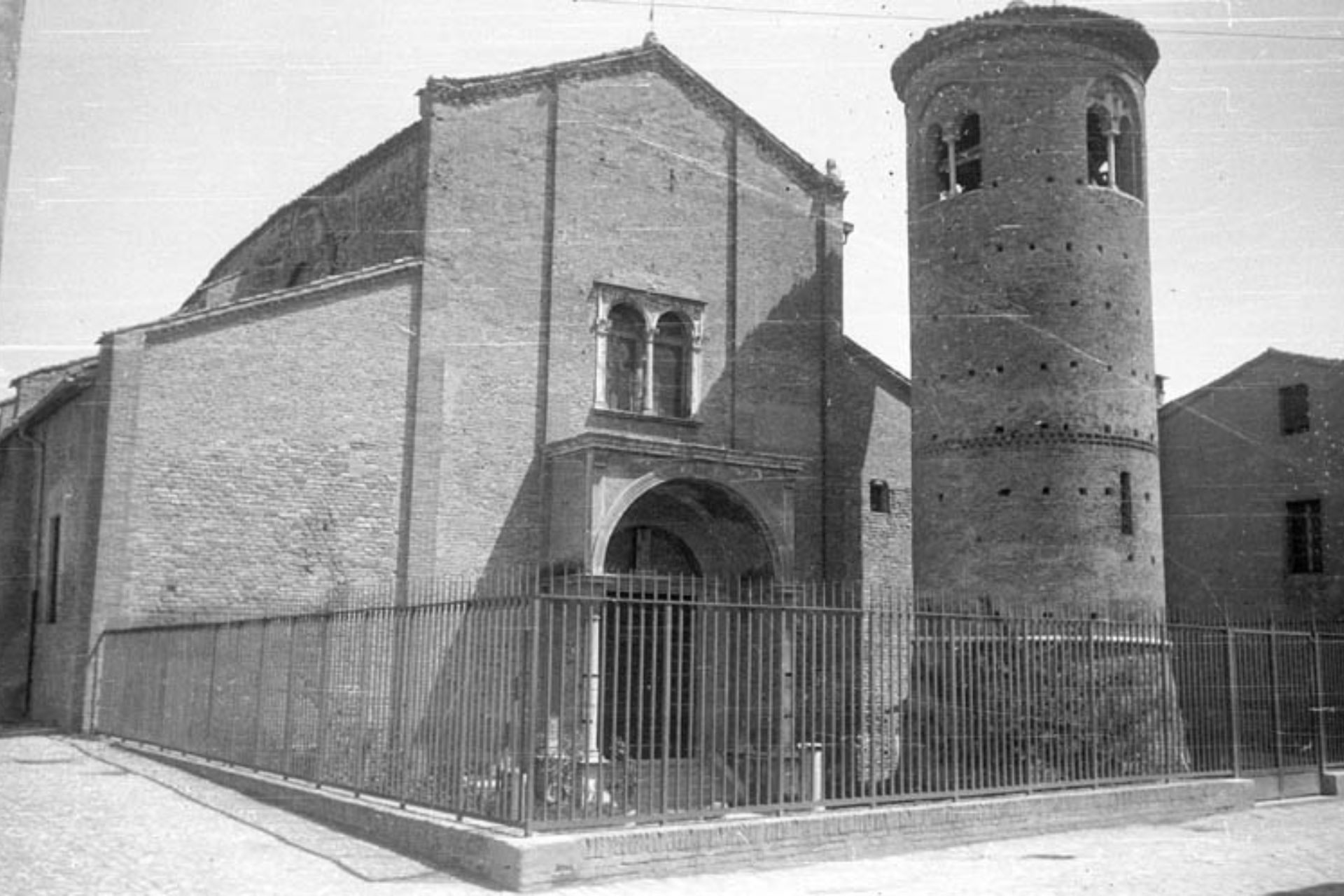
The original building was situated about 2.50 metres below the current level. In front of the façade, where there is now a garden, there was a four-sided portico, dismantled in Five hundred to make way for the bell tower. The following still survive from it: side door lintels, which are now buried, and some fragments of columns kept in the area in front of the church.
At the same time as the construction of the bell tower (1560), the following were placed inside four Renaissance altars, which are still present today. A earthquake at 1688 completely destroyed the apse mosaic and damaged the church’s structure: subsequently, the floor was raised by 2.50 metres and the apse was decorated with Baroque furnishings.
In the late Nineteenth century, during some excavations, the original mosaic floor, now kept elsewhere. Between the 1913 and 1918, Giuseppe Gerola He oversaw a radical restoration, removing the Baroque decorations and completing the façade with the porch and the Renaissance mullioned windows. The church sustained further damage in 1944 as a result of the bombing, which destroyed much of theapse and the Renaissance frescoes. The restoration of its original appearance took place between the 1960s and 1980s. Today (2020) the church is held regularly and open to visitors.
Description
Façade and porch
La façade, in its current form, is the result of the work carried out by the early 20th century. In the past, the front was partly hidden by homes and shops which were attached to it. The entire façade at key points It is made of cooked and punctuated by four pilasters central. The sides of the side aisles are floors, and at ground level one can still see the lintels of the ancient walled gates. The blind arches above them bear witness to the original shape of round arch. The central portal is preceded by an elegant porch, from the former Church of St Niccolò, who moved here in 1913. It is supported at the front by two columns and, on the back, from two fluted pillars; the sides are closed by Renaissance balustrades.
Garden and bell tower
Fra Via Mazzini and the façade extends for a small garden, situated slightly below the level of the church floor, which follows the layout of the ancient four-sided portico. Previously used as cemetery, is hosting today fourteen ancient sarcophagi. The oldest dates back to 6th century and features a carved cross which is reminiscent of that of the Arian Baptistery. Opposite the right-hand aisle stands the cylindrical bell tower (1560)with conical base e bell chamber opened by four mullioned windows supported by columns.
Interior
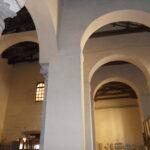
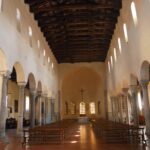
The interior, as we see it today, is the result of the 19th-century restorations and the early 20th century. It is divided into three naves, with the central one being more tall and wide, separated by two rows of ten counting columns, which vary in period and style. The central nave has been divided into two parts by a an archway built in the 19th century. The left-hand aisle also contains three supporting arches. Above the arches connecting the naves, there are narrow single-lancet windows, whilst the side windows retain their Baroque forms.
Front section
In the area between the rear façade and thecentral arch there are several artefacts discovered during the restoration work carried out between 1913 and 1918. You can see eight sarcophagi from different periods, one of which, dating from the late 6th century, is located at the entrance hall. Along the side walls are fragments of pluteus, registrations e Gothic elements. Near the archway in the right-hand aisle are bricks bearing old manufacturers’ marks. The remains of the side door arches originals.
Naves
The walls appear remains, the result of the removal of the Baroque decorations in the 20th century. The central nave is covered by timber trusses, replaced in the the 1980s. Engraved on the left-hand side of the arch is the the monogram of Bishop Peter II, with the letters ‘P’ and ‘E’ (Petrus, Bishop). Under theeighth arch On the left is the pulpit, in veined Greek marble, semi-cylindrical in shape and with a frieze decorated with leaves and pearls. The apse pillars are left exposed.
Side altars
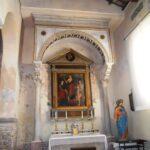
In the right-hand aisle there are four side altars. The first one, near the first column, is a frescoed niche with traces of Renaissance paintings. A little further on is the altar of Saint Rita of Casciawith 15th-century fresco and a modern statue. At the far end of the nave, the altar of Saint Agatha holds the relics of Saint Sergius the Martyr and the Bishop Agnello, and is topped by a painting by Luca Longhi (1546).
In the left-hand aisle is the baptistery, set between two pillars, with baptismal font on a column. Opposite the altar of Saint Rita stands the altar of St Francis, with a blade by G.B. Barbiani and a modern statue. The altar at the back is dedicated to the Our Lady of Good Counsel, decorated with two paintings by A. Barbiani. All four altars are covered by Renaissance hanging canopies.
Pipe organ
In the right-hand aisle is theMascioni pipe organ, Opus 891, composed in 1967, contained in a Neo-Renaissance wooden case. It is at electric transmissionwith two 61-note keyboards e 32-tooth concave-radial pedal set.
Apse and chancel
L'apse, situated at the end of the central nave, was severely damaged in the 1944 and reconstructed in the restoration work carried out in 1962–63, with the reopening of the five windows. They remain visible traces of 16th-century frescoes. The chancel, raised, features in the centre thehigh altarwith a 6th-century pluteus altar frontal depicting two peacocks and a Chrismon. On the wall is the the Chair of Rome, originating from thethe apse of Sant’Apollinare Nuovo.
The ancient mosaic in the apse
A drawing by Father Pronti gives us the only image of the apse mosaic destroyed by the the earthquake of 11 April 1688. The mosaic was divided into three bands: in the lower one, the Bishop Giovanni was celebrating on a square altar, alongside priests and from a angel with a chalice. Between the windows, there was a succession of stylised columns, and in the apse basin the … stood out Christ on the Throne, Bestowing a Blessing, in a scarlet cloak, between two archangels dressed in white. Today’s raising the floor He would cut that scene in half today.