The Cervia Salt Pan Park Association
Founded in 2002 thanks to the collaboration of various local authorities, including the Municipality of Cervia, the Province of Ravenna, the Po Delta Park and the Ravenna Chamber of Commerce, this organisation was established as a joint initiative of its founding members. With a structure comprising 92% public shareholdings, it includes a single private shareholder, namely the Terme di Cervia in Brisighella.
The organisation’s main objective is to manage and promote the entire Cervia salt pans complex and the surrounding area, whilst ensuring the protection of the environment, ecological balance and the cultural heritage of the area.
The salt pan
Situated at the southern end of the Po Delta Park and serving as its gateway, the Salina is an area of great natural and scenic importance. It covers an area of 827 hectares, some 1,600 metres from the coast.
It is Italy’s northernmost salt marsh and is situated within a nature reserve, which now serves as the southern gateway to the Po Delta Park. It has always been a valuable nature reserve due to the presence and reproduction of numerous animal and plant species.
The collection
In 1959, the saltworks underwent a radical transformation: the traditional system of multiple harvests, based on small, family-run salt pans, was abandoned in favour of a single, industrial-scale harvest. This change affected 144 salt pans, which were brought together into a centralised system. The new approach involved harvesting the salt in a few dozen basins, known as ‘salanti’, at the end of summer, thanks to the introduction of advanced and technologically sophisticated machinery.
Cervia Salt Pan
The Camillone Saltworks is the only one still operating using traditional methods, thanks to the voluntary efforts of the Civiltà Salinara Cultural Group. This salt pan produces salt of the very highest quality, recognised as a Presidio Slow Food.
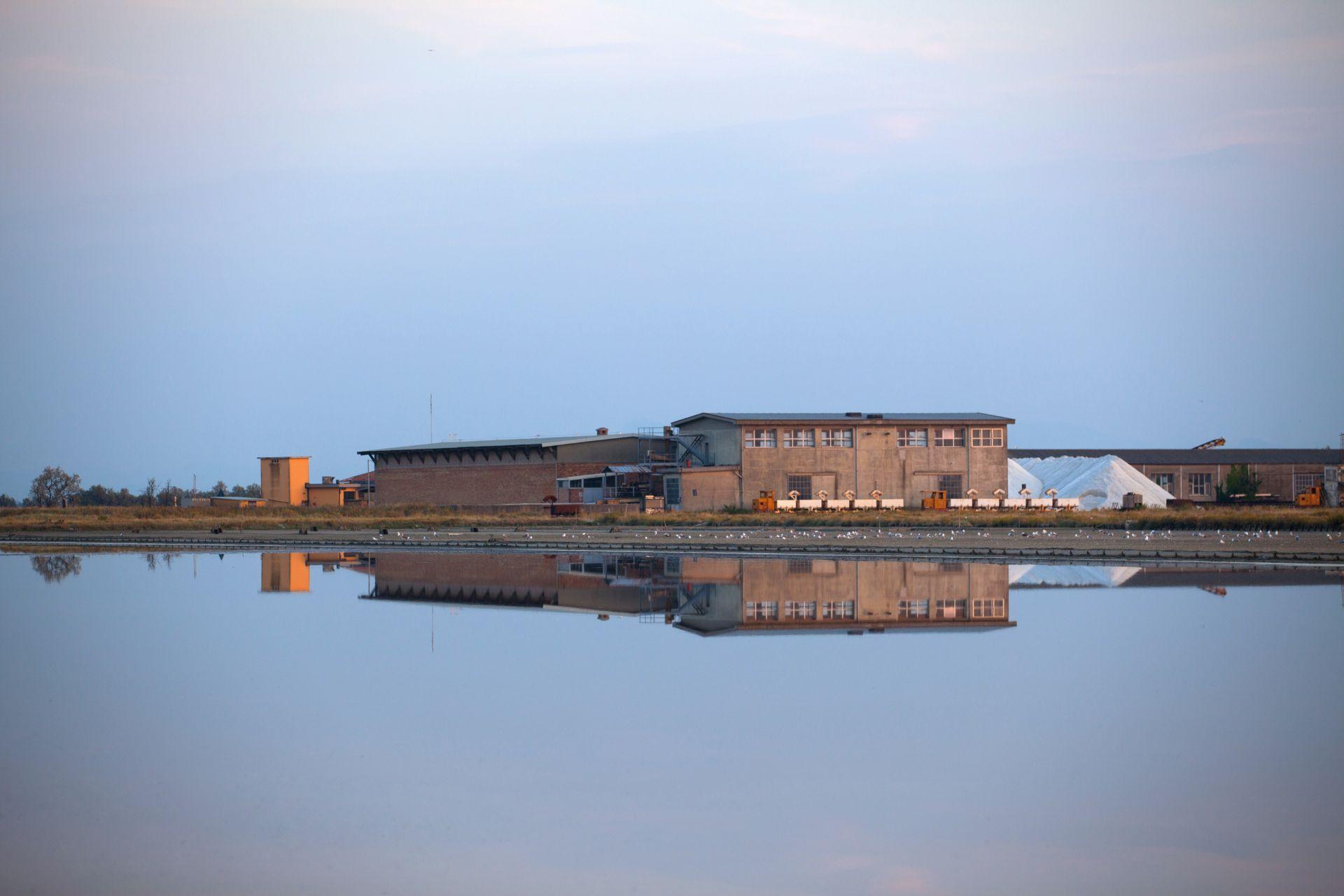
Inside, there is a visitor centre, housed in a renovated former abattoir, which now serves as a meeting point for nature lovers and birdwatchers. The centre is also one of the main observation points for the study and census of bird migrations along the Adriatic route. Guided tours set off from here through the Cervia Salt Pans, offering itineraries that explore the history and economics of salt production.
The salt marsh ecosystem
The waters of the Salina are home to theArtemia salina, a small reddish crustacean, up to 15 mm long, which plays a vital role in salt production. This organism feeds on algae and detritus, helping to keep the water in the ponds clear. The greater clarity of the water allows sunlight to penetrate more easily, accelerating evaporation.
L'Artemia salina It is also an essential part of the food chain, attracting various species of birds such as the flamingo, the shelduck and numerous waders, including the pied avocet and the black-winged stilt, which feed on it.
Structure and collection
The salt pan covers about a third of Cervia’s municipal area, comprising over 50 basins surrounded by a canal more than 16 kilometres long, which allows seawater from the Adriatic Sea to flow in. The salt is harvested from the basins, known as ‘rango’, which are divided into three large pools, each approximately one kilometre long and 453 metres wide.
The salt is still produced and harvested using traditional methods, although a conveyor belt and a trolley – similar to a small train – are used. However, at the Camillone Salt Pan, which forms part of the Salt Museum (Musa), the harvest is still carried out by hand, evoking the traditional ritual of the cavadura, which is celebrated between the end of August and the beginning of September.
The Cavadura
La cavadura It is the term used to describe the process of harvesting salt.
Seawater is fed into the salt pan via the inlet channel, situated in Milano Marittima near the Prima Traversa. From there, the water is channelled through a complex system of ring canals that extend throughout the Cervia area, controlled by locks and sluice gates.
After passing through the basins, the water flows out via another channel that runs alongside the harbour canal, passing close to the Salt Warehouses, which were once used to store the product, and to the San Michele Tower, who watched over this precious treasure.
At each stage, the seawater is channelled into the basins where, thanks to the combination of sun and wind, the evaporation process begins, leading to the formation of salt. Once harvested, the salt is still wet and very heavy, with a distinctive pink colour. This particular colour is due to the presence of algae Dunaliella, rich in lycopene and beta-carotene, which grows in salt pans.
Salt
The salt produced at the Cervia Salt Pan is a sweet salt, sea salt and wholegrain. It is described as wholegrain because, after harvesting, it is washed exclusively with mother liquor. This solution, with a salt concentration higher than that of seawater but lower than that of table salt, is particularly rich in trace elements and substances beneficial to the body’s wellbeing. Drying takes place in large drying yards, where the salt is arranged in striking mounds that catch the eye of anyone visiting Cervia.
The Sweetness of Salt
The distinctive sweetness of this salt stems from geographical, historical and chemical factors. The salt pan’s northern location, the unique characteristics of its basins and the conditions of the Adriatic Sea mean that the salt consists mainly of high-purity sodium chloride, with only trace amounts of the more bitter chlorides, such as magnesium sulphate, calcium sulphate, potassium chloride and magnesium chloride, which are almost entirely absent.
Drying method
The salt is dried naturally, without the use of artificial processes or chemical bleaching. This approach preserves its full qualities, ensuring high solubility. It also retains its natural moisture, a result of the production process, and its characteristic colour, which varies in delicate shades of pink and grey.
The story
The history of Cervia is inextricably linked to its salt pan.
Between the late 1980s and the early 1990s, the State monopoly, which had managed the national saltworks for much of the 20th century, began a process of divesting itself of certain assets, including the Cervia Saltworks. This decision deeply shocked the local community, which responded by mobilising to save them. This initiative was not only a gesture of economic self-defence but also a way of protecting a deeply felt and widely shared symbol of local identity.
The state body considered the Cervia Salt Pan to be too small and unprofitable, but the local people regarded it as essential, not only for the local economy but also to prevent the area from becoming waterlogged. The subsequent recognition of the salt pan as a landscape and ecosystem heritage site represented an act of justice, emphasising that a community’s greatest treasure lies in its history and its landscape.
Cervia salt products and derivatives
The products from the saltworks are produced in accordance with strict quality standards and in keeping with tradition.
Cervia Sweet Salt
A high-quality salt, renowned for its unique and delicate flavour.
Aromatic Salts
Blends of table salt enriched with herbs and spices.
Chef’s Salt Brick from Cervia
A slab of pure, mild salt, ideal for cooking or for use in cold dishes, which adds flavour to food.
Wellness and Cosmetics Range
Natural, paraben-free products that harness the properties of salt to promote skin wellbeing.
Branded Products
Cervia salt is also used in the food industry. Its mild flavour enhances the taste of meat in cured meats and aids the maturing of dairy products, without overpowering the taste of fresh milk.