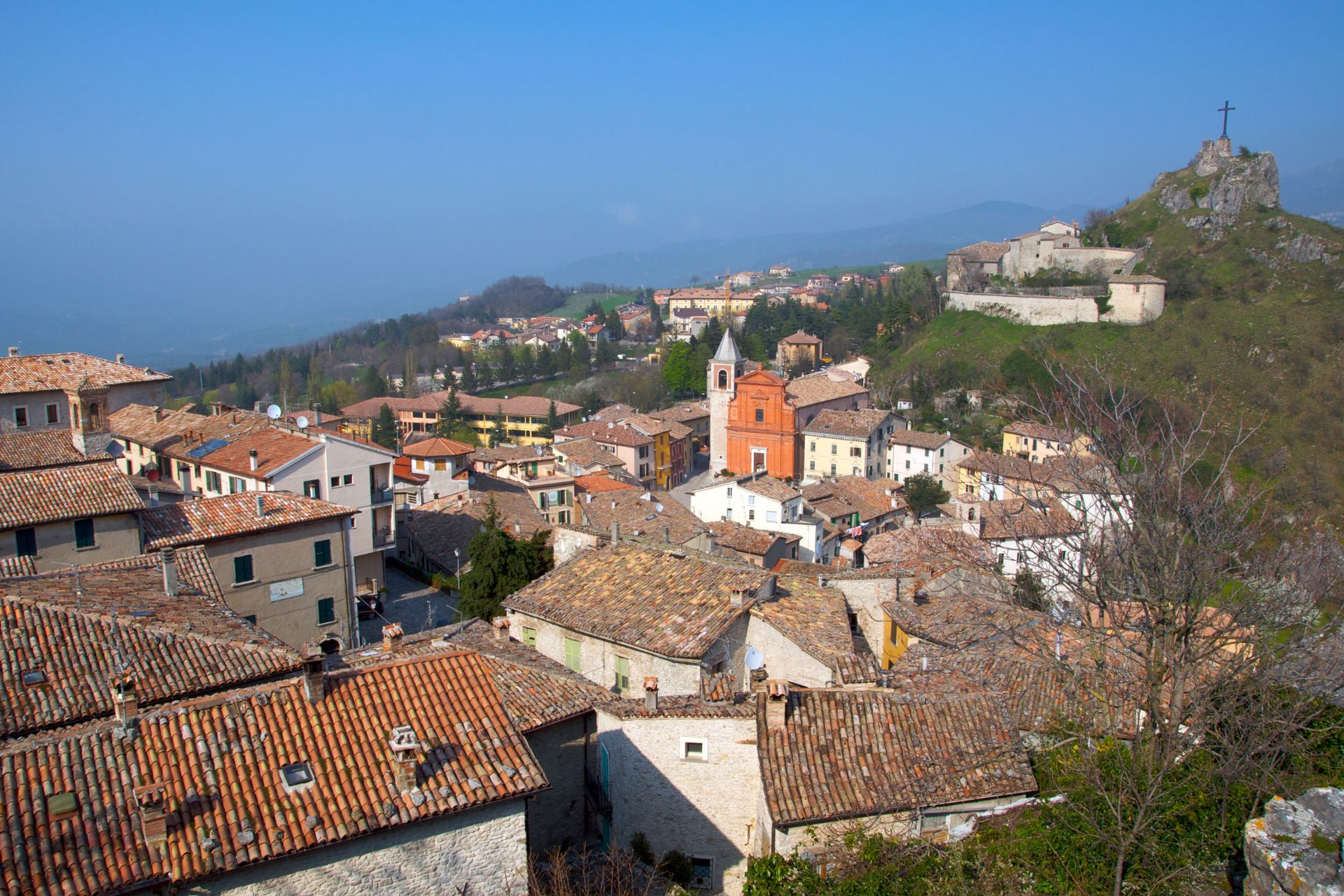
Nestled amongst the hills of Romagna, in the Bertinoro area, stands a religious building that encapsulates centuries of history, art and literary inspiration: the parish church of San Donato in Polenta. Let’s find out about its origins and what we know of its history
This ancient church, situated in the hamlet of Polenta, is one of the the most interesting historic sites in the Forlì hinterland It is a must-see for anyone wishing to explore the cultural heritage of Romagna. Its origins are very ancient and, although it is not possible to establish with absolute certainty when the first place of worship was built, the presence of the parish church has been documented since at least the early 10th century. Over the years, the church has been altered, restored and renovated, whilst retaining architectural features that bear witness to the various phases of its long history.
Visitors to Bertinoro and the surrounding area can therefore include the Parish of Polenta Bertinoro Among the places to discover on a tour of thethe Romagna hinterland. The parish church is not only of religious interest: the the medieval history of the region, the story of the the Da Polenta family, the tradition associated with Dante Alighieri and the relationship with Giosuè Carducci, who dedicated a famous ode to the church in the late nineteenth century.
The origins of the parish church of San Donato in Polenta
To determine precisely the date of construction of the Parish Church of San Donato It is not straightforward. The theories put forward by scholars over the years place its origins in a period ranging from the Early Middle Ages to the centuries immediately following. Historical records provide a firm basis: The existence of the parish church is first recorded in a document dated 911. Some elements of the building, however, have been traced back to an earlier period and to the influence of Lombard art.
The same dedication to San Donato, a saint particularly venerated in the Arezzo area, has helped to fuel speculation regarding a very ancient foundation. According to one of the proposed theories, the church’s origins may date back to the period of the Lombard presence in central and northern Italy. However, this is an area in which it is necessary to distinguish between historical hypotheses and reliable documentary evidence.
La The parish church played an important role in the medieval region. The term ‘pieve’ referred to a church with specific religious functions, situated at the centre of a rural area. These buildings served as points of reference – not only spiritual but also social – for the communities living in the surrounding countryside. The location of the Pieve di San Donato, in the hills of Bertinoro, it must therefore be understood within the context of a medieval landscape in which small settlements, parish churches, castles and connecting roads formed a network that was essential to the lives of the local population.
The architecture of the parish church of Polenta
One of the most interesting aspects of the Parish Church of San Donato in Polenta It concerns its architectural structure. The church features a basilical layout and an interior characterised by massive columns made of stone and brick.
Of particular significance are the capital columns of the parish church of Polenta, which do not share uniform characteristics. Some have relatively simple shapes, whilst others feature geometric decorations, animal figures, anthropomorphic elements and ornamental motifs attributable to various artistic influences. Indeed, columns, capitals and crypt They are among the elements associated with the earliest stages of construction.
Inside, there is also an ancient marble altar frontal from the high altar, decorated with a cross and bas-reliefs. Overall, the appearance of the church gives an insight into how the Pieve di Polenta is the result of a long history of historical and architectural development: The building that has survived to the present day does not correspond entirely to the original structure, but it retains traces of the various periods it has gone through.
The restoration work that transformed the church
Over the centuries, the Parish Church of San Donato It has undergone numerous alterations. One of the most significant dates back to 1705, when particularly radical restoration work was carried out, which significantly altered the appearance of the church.
Another key phase took place at the end of the nineteenth century. In 1890, further work was carried out, and the crypt of the parish church of Polenta. A few years later, work was also carried out on the bell tower: the reconstruction work began in 1898 and was completed the following year.
Even in much more recent times, the building has required attention to ensure its preservation. Following reports of structural problems at the end of the 20th century and subsequent safety measures, a major restoration programme was carried out between 2009 and 2012.
These initiatives demonstrate just how much the conservation of the parish church of Polenta was considered important for preserving one of the most iconic monuments of the the Bertinoro area.
The Parish Church of Polenta, Dante and the Da Polenta family
A significant part of the church’s charm stems from its links to medieval history and Italian literature. The Polenta area is, in fact, associated with the the Da Polenta family, a family said to have taken its name from the castle of the same name and which came to play a leading role in medieval Ravenna’s political life.
The name ‘Da Polenta’ inevitably leads to Dante Alighieri. The poet, in fact, spent the latter part of his life in Ravenna under the protection of Guido Novello da Polenta. This historical fact gave rise to one of the most fascinating traditions associated with the parish church: according to tradition, Dante is said to have visited San Donato in Polenta and to have stopped there to pray.
The possible move of Dante at the Pieve di Polenta It has become deeply ingrained in the local collective imagination, but it must be presented for what it is: a tradition, not an event substantiated by reliable contemporary documentation. The link between Dante, Bertinoro and Polenta It still contributes to the historical and literary charm of the place today.
Giosuè Carducci and ‘The Church of Polenta’
Whilst the relationship with Dante is partly rooted in tradition, that between the Pieve di Polenta and Giosuè Carducci This, on the other hand, is well documented. The poet spent time in Romagna and visited Bertinoro and the church of San Donato. In 1897, he dedicated an ode to the parish church “The Church of Polenta”, which was subsequently included in the collection *Rime e ritmi*.
Carducci knew these hills well, partly thanks to his relationship with the Pasolini Zanelli family and his stays at Villa Silvia, in the hills near Cesena. The parish church became for him a place where history, landscape and literary heritage They seemed to meet.
The poet also helped to draw attention to the condition of the building and the need to preserve it. His interest was part of the movement that led to the late 19th-century restoration work and the reconstruction of the bell tower. Even today, the the connection between Carducci and Polenta It is one of the fundamental elements of the area’s cultural identity.
The Parish Church of Polenta as part of a tour of Bertinoro
Visit the Parish Church of San Donato It also means discovering a part of thethe Romagna hinterland different from the coastal resorts. Bertinoro It is known for its panoramic setting amongst the hills and for its historical heritage, in which religious buildings, villages, medieval remains and local traditions coexist within a relatively compact area.
The hamlet of Polenta also preserves the memory of thean ancient castle associated with the Da Polenta family, placing the parish church within a broader historical context. The village and the church therefore provide the basis for a tour dedicated to Medieval Romagna, the history of Bertinoro and its links with some of the most important figures in Italian literature.
For those looking for What to see in Bertinoro and the surrounding area, the Parish Church of San Donato is therefore a particularly interesting stop. The significance of the place stems precisely from the interplay of various layers of interpretation: its religious history, its medieval architecture, the changes it has undergone over the centuries, the Da Polenta family, its connection to Dante, and Carducci’s work.
A place where history and literature come together
La History of the Parish Church of San Donato in Polenta It cannot be traced back to a single point in time. Its origins remain, to some extent, a matter of interpretation, whilst the historical records allow us to trace its history with greater certainty from at least the 10th century onwards. Since then, the church has undergone transformations, restorations and difficult periods, whilst managing to preserve important evidence of its earliest phases.
What makes this place so special, however, is also what has happened in connection with its material history. The presence of the From Polenta, the tradition of the handover of Dante and, above all, the documented relationship with Giosuè Carducci They have transformed a small parish church in the hills of Romagna into a place with a strong cultural identity.
Today, the Parish Church of San Donato in Polenta It therefore represents much more than just an ancient religious building. It is a testament to the History of the Bertinoro hinterland, an example of the architectural stratification that has taken place over the centuries and a place where the landscape of Romagna continues to engage with its historical and literary heritage.